A Level Accounting (9706)•9706/13/M/J/18
A Level Accounting (9706) — 9706/13/M/J/18, Question 2
Why is depreciation charged on non-current assets?
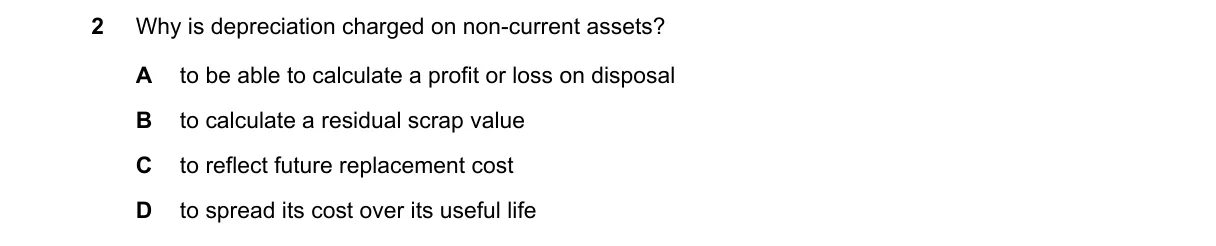
Answer choices
- Ato be able to calculate a profit or loss on disposal
- Bto calculate a residual scrap value
- Cto reflect future replacement cost
- Dto spread its cost over its useful life
Explanation
Depreciation allocates asset costs over useful life
Steps:
- Identify purpose of depreciation: it systematically reduces asset value in financial statements.
- Recall accounting principle: costs must match revenues they generate over time.
- Evaluate choices: A relates to disposal, not ongoing charge; B is end-value estimate; C ignores historical cost; D aligns with spreading cost.
- Confirm D: matches cost to periods of benefit.
Why D is correct:
- Per matching principle in accounting, depreciation spreads an asset's cost over its useful life to allocate expenses to revenue-generating periods.
Why the others are wrong:
- A: Disposal profit/loss uses accumulated depreciation but isn't the reason for charging it annually.
- B: Scrap value reduces depreciable amount but doesn't explain charging depreciation.
- C: Depreciation reflects historical cost allocation, not future replacement prices.
Final answer: D
Topic: Accounting for non-current assets
Practice more A Level Accounting (9706) questions on mMCQ.me