A Level Accounting (9706)•9706/11/M/J/18
A Level Accounting (9706) — 9706/11/M/J/18, Question 15
The following statements relate to a revaluation account. 1 An entry on credit side of the revaluation account means that a non-current asset has fallen in value. 2 If a credit entry is required to close off a revaluation account there is a profit on revaluation. Which of these statements?
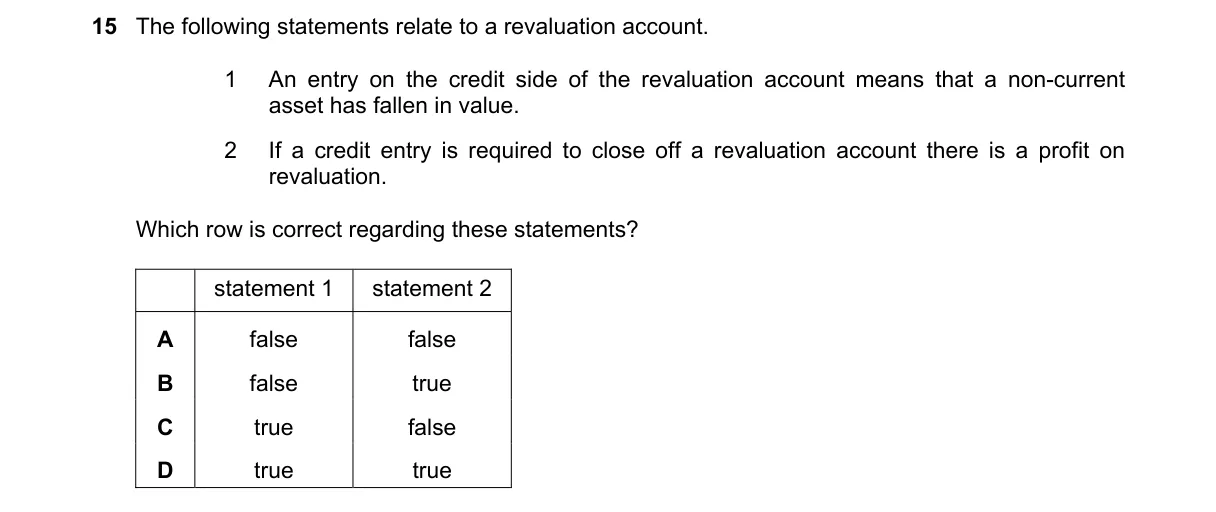
Answer choices
- AStatement 1: false, Statement 2: true
- BStatement 1: false, Statement 2: false
- CStatement 1: true, Statement 2: false
- DStatement 1: true, Statement 2: true
Explanation
Revaluation account entries and closing for asset changes
Steps:
- Credit side of revaluation account records gains, such as increases in non-current asset values (Dr Asset, Cr Revaluation).
- Thus, a credit entry means asset value has risen, not fallen: statement 1 false.
- Debit side records losses, like decreases in asset values (Dr Revaluation, Cr Asset).
- If net profit (credit balance), close by Dr Revaluation, Cr Partners' capitals: credit entry to capitals indicates profit, statement 2 true.
Why A is correct:
- A identifies statement 1 as false (credit side for gains, per standard partnership revaluation entries) and 2 as true (closing profit requires crediting capitals).
Why the others are wrong:
- B incorrectly deems statement 2 false, ignoring credit to capitals in profit closure.
- C incorrectly deems statement 1 true, as credit side signals asset rise, not fall.
- D deems both true, contradicting credit side meaning.
Final answer: A
Topic: Accounting for non-current assets
Practice more A Level Accounting (9706) questions on mMCQ.me