A Levels Physics (9702)•9702/13/O/N/24
A Levels Physics (9702) — 9702/13/O/N/24, Question 8
What can be deduced about the motion of the stone?
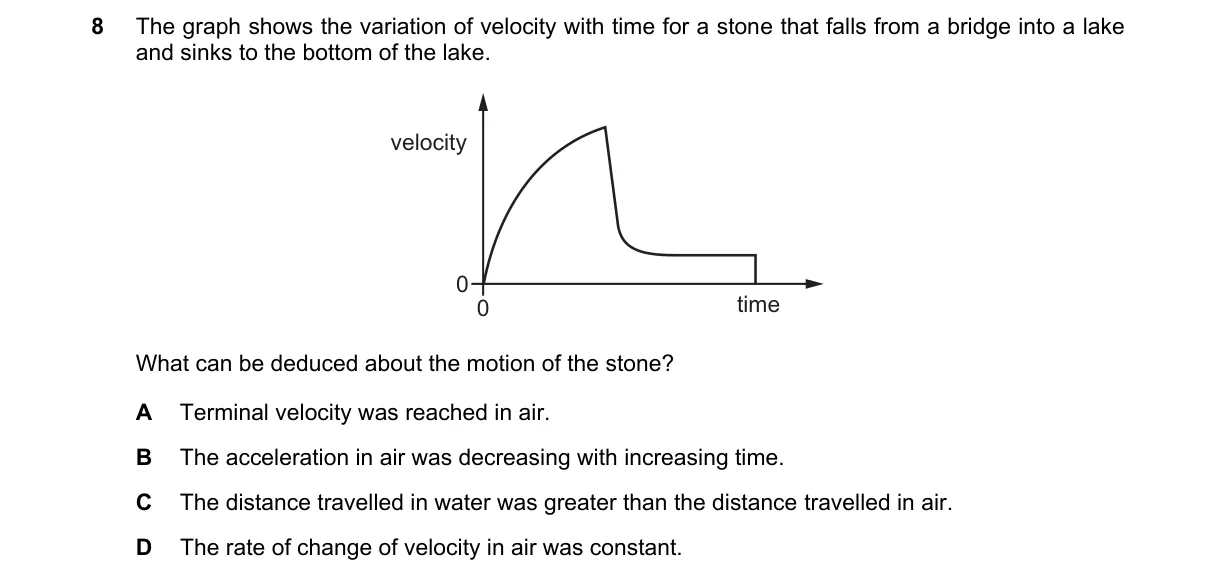
Answer choices
- ATerminal velocity was reached in air.
- BThe acceleration in air was decreasing with time.
- CThe distance travelled in water was greater than the distance travelled in air.
- DThe rate of change of velocity in air was constant.
Explanation
Air resistance reduces acceleration over time
Steps:
- Observe velocity-time graph for stone in air: velocity increases but at decreasing rate.
- Acceleration is slope of velocity-time graph; decreasing slope means decreasing acceleration.
- In air, drag force opposes motion and grows with speed, reducing net force.
- Deduce acceleration decreases due to increasing air resistance.
Why B is correct:
- Newton's second law: net acceleration a = (mg - drag)/m; drag ∝ v or v² increases with time, so a decreases.
Why the others are wrong:
- A: Terminal velocity requires zero acceleration; graph shows ongoing increase.
- C: Not enough information on distances or times in air vs. water.
- D: Constant acceleration would mean straight-line velocity graph; it's curved.
Final answer: B
Topic: Non-uniform motion
Practice more A Levels Physics (9702) questions on mMCQ.me