A Levels Physics (9702)•9702/13/O/N/24
A Levels Physics (9702) — 9702/13/O/N/24, Question 34
The potential difference (pd) across a fixed resistor is V. The power dissipated in the resistor is 5.0 W. The pd across the resistor then changes to a new value. With the new pd, the energy transferred to the resistor in a time of 2.5 s is 50 J. What is the new pd across the resistor?
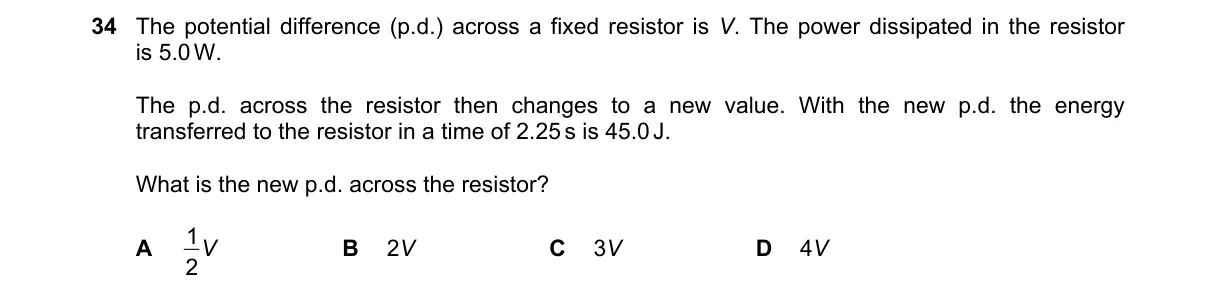
Answer choices
- A½ V
- B2 V
- C3 V
- D4 V
Explanation
Power-voltage relationship in resistors
Steps:
- Initial power P = V²/R = 5 W, so R = V²/5 Ω.
- New energy E = 50 J in t = 2.5 s, so new power P' = E/t = 50/2.5 = 20 W.
- New pd = V', so P' = V'²/R = 20 W.
- Substitute R: 20 = V'²/(V²/5), so V'²/V² = 4, V' = 2V.
Why B is correct:
- Power P ∝ V² for fixed R; new P' = 4 × initial P requires V' = √4 × V = 2V.
Why the others are wrong:
- A: ½V gives P' = (1/4)×5 = 1.25 W, E = 3.125 J (too low).
- C: 3V gives P' = 9×5 = 45 W, E = 112.5 J (too high).
- D: 4V gives P' = 16×5 = 80 W, E = 200 J (too high).
Final answer: B
Topic: Potential difference and power
Practice more A Levels Physics (9702) questions on mMCQ.me