A Levels Physics (9702)•9702/13/O/N/24
A Levels Physics (9702) — 9702/13/O/N/24, Question 30
A vibrating bar produces surface water waves in a ripple tank. The vibrating bar produces waves of 5.0 cm wavelength and they pass through a gap of width 20 cm. Which change will decrease the amount of diffraction that is observed?
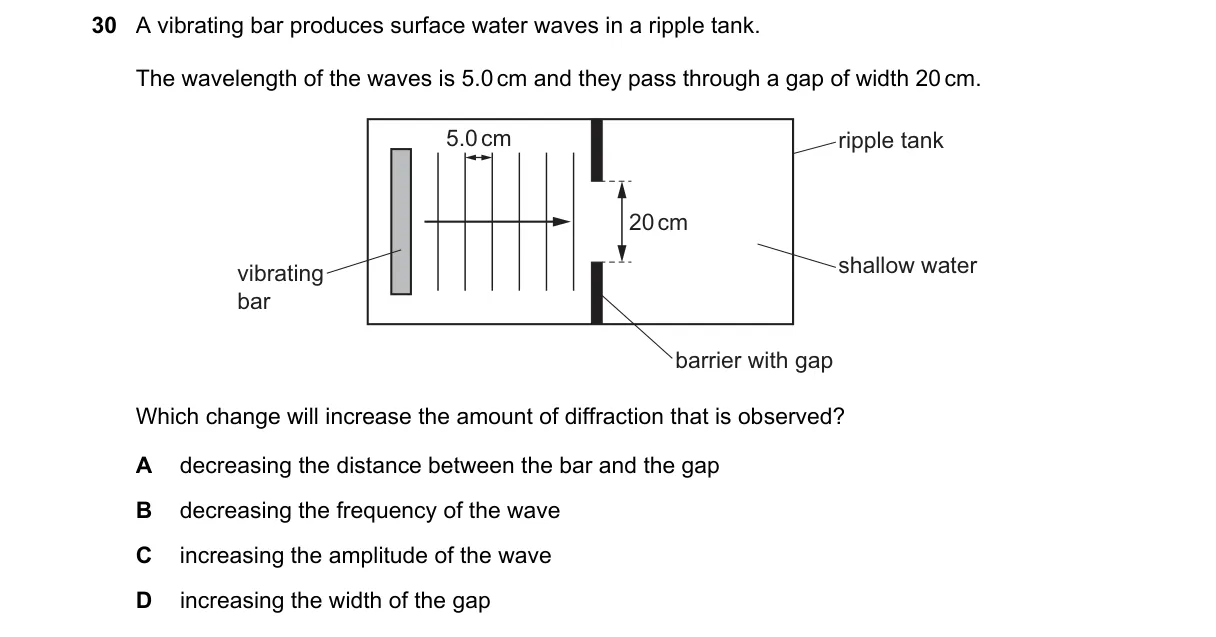
Answer choices
- Adecreasing the distance between the bar and the gap
- Bdecreasing the frequency of the wave
- Cincreasing the amplitude of the wave
- Dincreasing the width of the gap
Explanation
Diffraction decreases with larger wavelength relative to gap width
Steps:
- Diffraction is most noticeable when wavelength (λ) is comparable to or larger than gap width (d); here, λ = 5 cm, d = 20 cm, so λ < d and diffraction is moderate.
- Wave speed v is constant in the ripple tank, so λ = v / f, where f is frequency.
- Decreasing f increases λ, making λ/d smaller and reducing diffraction.
- Other changes do not alter the λ/d ratio in a way that decreases diffraction.
Why B is correct:
- Decreasing frequency increases wavelength (λ = v/f), reducing the λ/d ratio and thus diffraction, per the diffraction condition for single slits.
Why the others are wrong:
- A: Distance to gap affects wave coherence but not diffraction amount through the gap.
- C: Amplitude affects wave intensity, not the diffraction pattern's angular spread.
- D: Increasing gap width increases d, making λ/d smaller and actually increasing diffraction.
Final answer: B
Topic: Diffraction
Practice more A Levels Physics (9702) questions on mMCQ.me