A Levels Physics (9702)•9702/13/O/N/24
A Levels Physics (9702) — 9702/13/O/N/24, Question 20
The equation for kinetic energy, KE, can be derived using the equations of motion. Four equations relating to motion are listed. 1 v² = u² + 2as 2 v = u + as 3 s = (v + u)t / 2 4 p = mv Which three equations can be used to derive the equation for KE?
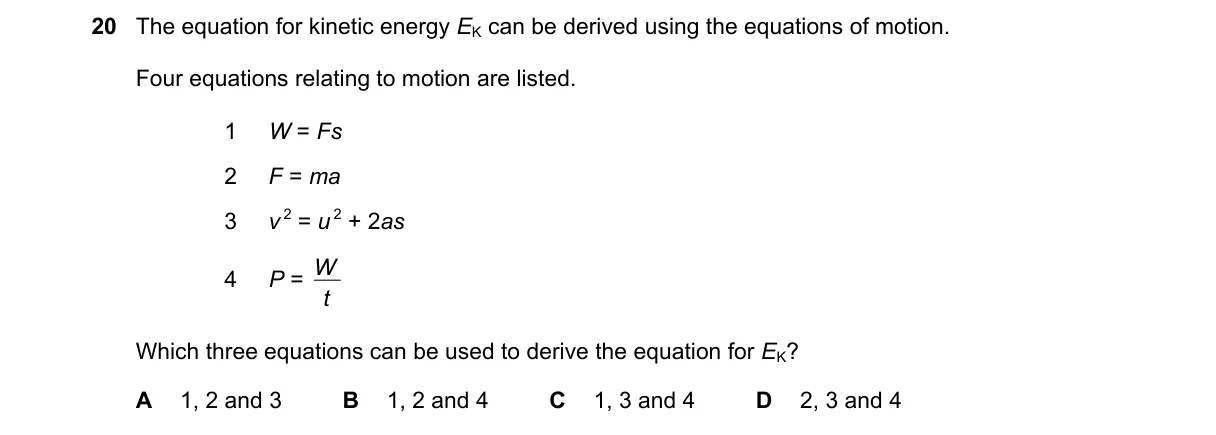
Answer choices
- A1, 2 and 3
- B1 and 4
- C1 and 3 and 4
- D2 and 3 and 4
Explanation
Deriving KE from kinematic equations and work principle
Steps:
- Start with work done by net force: W = F × s = ma × s (constant acceleration).
- Use equation 2 (v = u + at) to express a = (v - u)/t.
- Substitute into equation 3 (s = (u + v)t/2) to get as = (v - u)(u + v)/2 = (v² - u²)/2.
- Thus, W = m(v² - u²)/2 = ½mv² - ½mu², defining KE = ½mv² (equation 1 confirms the velocity relation).
Why A is correct:
- Equations 1, 2, and 3 are the core kinematic relations that combine to yield the velocity-displacement link needed for the work-energy theorem, deriving ΔKE = W.
Why the others are wrong:
- B: Lacks equations 2 and 3; equation 4 (momentum) is unrelated to energy derivation.
- C: Excludes equation 2; momentum (4) doesn't provide acceleration-time relation.
- D: Omits equation 1; momentum (4) isn't kinematic and can't derive velocity-squared term.
Final answer: A
Topic: Gravitational potential energy and kinetic energy
Practice more A Levels Physics (9702) questions on mMCQ.me