A Levels Physics (9702)•9702/13/O/N/24
A Levels Physics (9702) — 9702/13/O/N/24, Question 18
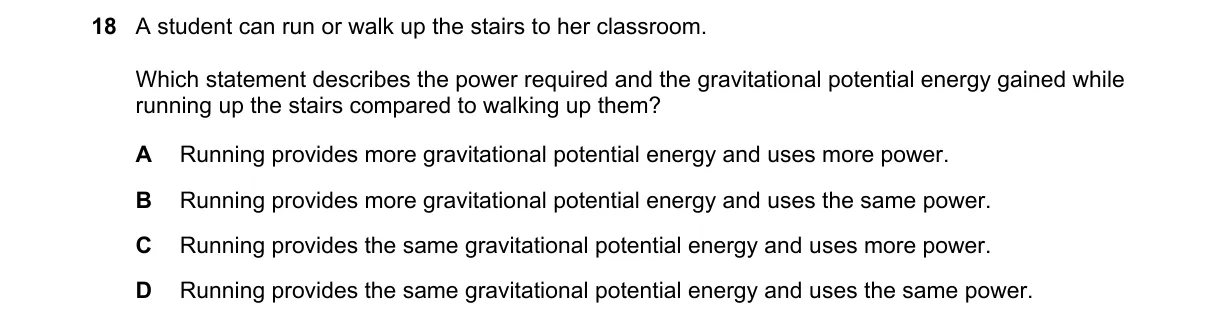
A student can run or walk up stairs to her classroom. Which statement describes the power required and the gravitational potential energy gained while running up the stairs compared to walking up them.
Answer choices
- ARunning provides more gravitational potential energy and uses more power.
- BRunning provides more gravitational potential energy and uses the same power.
- CRunning provides the same gravitational potential energy and uses more power.
- DRunning provides the same gravitational potential energy and uses the same power.
Explanation
Power Depends on Speed, Potential Energy on Height
Steps:
- Gravitational potential energy gained equals mgh, where h is the stair height, same for both methods.
- Mass m and g are constant, so ΔPE is identical regardless of running or walking.
- Power P equals work (ΔPE) divided by time Δt.
- Running reduces Δt compared to walking, increasing P while ΔPE stays the same.
Why C is correct:
- ΔPE = mgh is independent of speed; P = ΔPE/Δt increases with shorter Δt for running.
Why the others are wrong:
- A: ΔPE is the same, not more for running.
- B: ΔPE is the same, and power is more, not the same.
- D: Power is more for running, not the same.
Final answer: C
Topic: Gravitational potential energy and kinetic energy
Practice more A Levels Physics (9702) questions on mMCQ.me