A Levels Physics (9702)•9702/11/O/N/24
A Levels Physics (9702) — 9702/11/O/N/24, Question 5
An object is projected from horizontal ground at a velocity of magnitude u at angle θ to the horizontal. It hits the ground at time t after it is projected. Assume air resistance is negligible. Which statement does not describe the motion of this object?
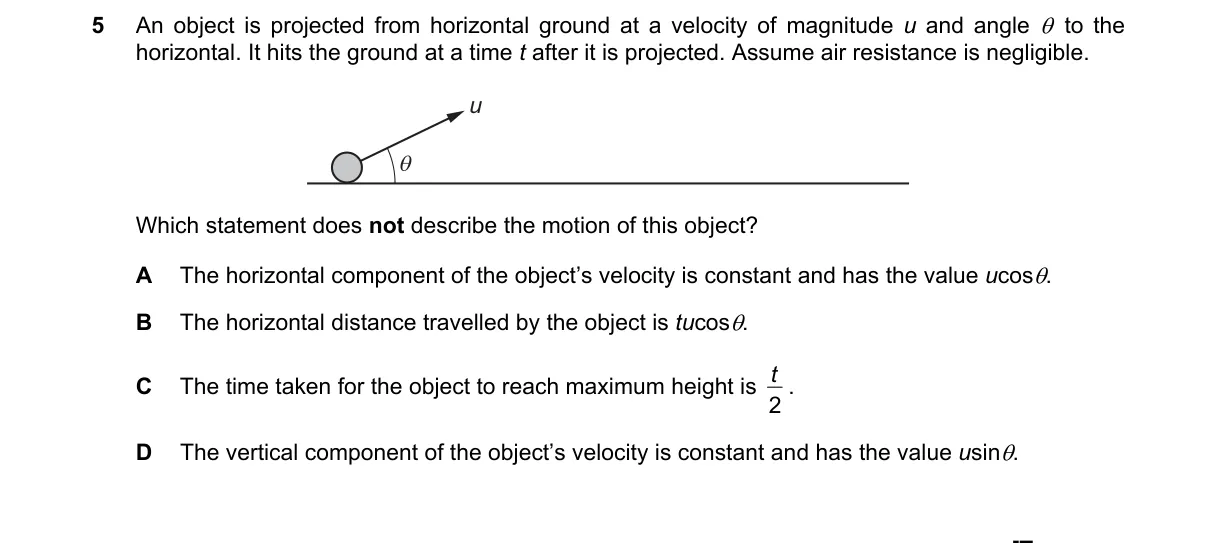
Answer choices
- AThe horizontal component of the object's velocity is constant and has the value u cos θ
- BThe horizontal distance travelled by the object is u t cos θ
- CThe time for the object to reach maximum height is t/2
- DThe vertical component of the object's velocity is constant and has the value u sin θ
Explanation
Projectile Motion Basics
Steps:
- Resolve initial velocity u into horizontal (u cos θ, constant) and vertical (u sin θ, decelerates at g) components.
- Total time of flight t = (2 u sin θ)/g, so time to max height = (u sin θ)/g = t/2.
- Horizontal distance (range) = (u cos θ) * t.
- Vertical velocity changes due to gravity: starts at u sin θ, becomes -u sin θ at landing.
Why D is correct:
- Vertical velocity is not constant; it decreases linearly under constant acceleration g downward (from Newton's second law).
Why the others are wrong:
- A: Horizontal velocity is constant (no horizontal acceleration).
- B: Horizontal distance equals constant horizontal velocity times total time.
- C: Symmetric motion makes ascent and descent times equal, so max height at t/2.
Final answer: D
Topic: Equations of motion
Practice more A Levels Physics (9702) questions on mMCQ.me