A Levels Physics (9702)•9702/11/O/N/24
A Levels Physics (9702) — 9702/11/O/N/24, Question 37
A potentiometer circuit is used to determine the electromotive force (e.m.f.) of a cell. The circuit includes a second cell of e.m.f. 1.5 V and internal resistance 0.50 Ω that is connected to a uniform resistance wire XY, as shown. The resistance wire XY has a length of 0.6 m and a resistance of 0.50 Ω. The movable connection Z is moved along wire XY. The galvanometer reading is zero when length XZ is 0.64 m. What is the e.m.f. of the cell?
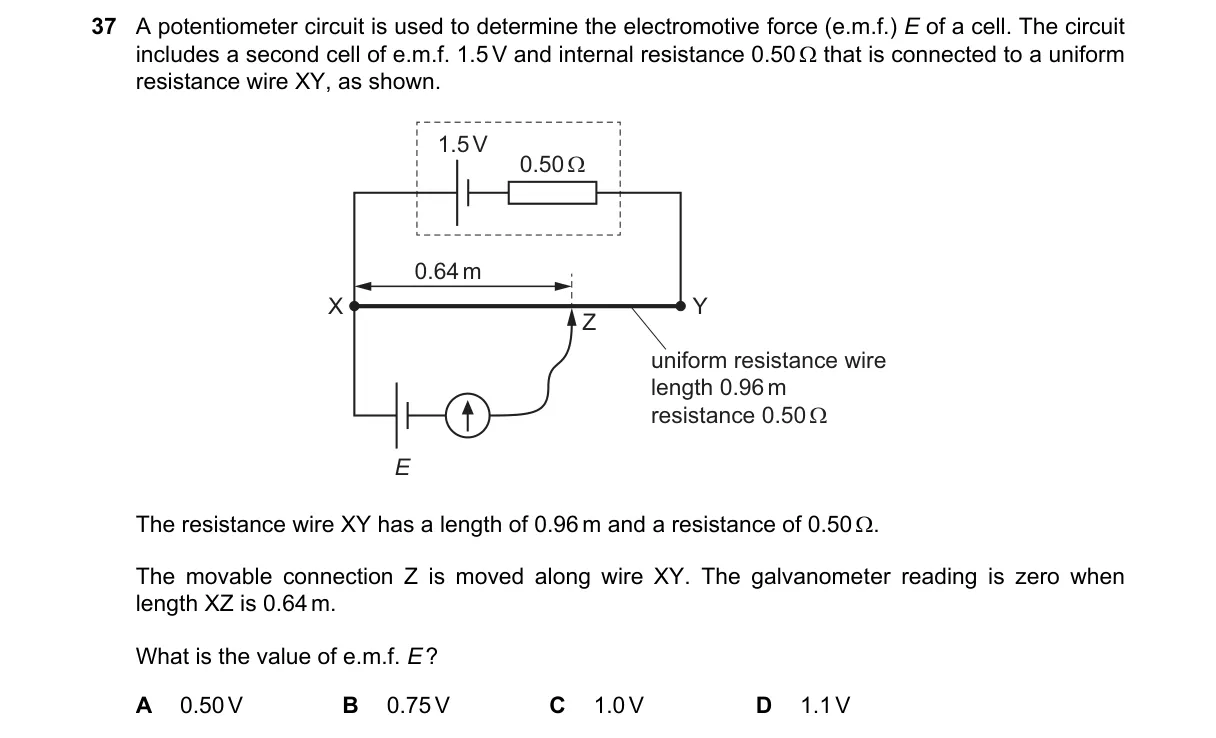
Answer choices
- A0.50 V
- B0.75 V
- C1 V
- D1.5 V
Explanation
Potentiometer null point balances unknown e.m.f. with potential drop across XZ
Steps:
- Total resistance of driver circuit: 0.50 Ω (internal) + 0.50 Ω (wire) = 1.0 Ω.
- Driver current: 1.5 V / 1.0 Ω = 1.5 A.
- Potential difference across wire XY: 1.5 A × 0.50 Ω = 0.75 V.
- Potential gradient: 0.75 V / 0.6 m = 1.25 V/m.
- Unknown e.m.f.: 1.25 V/m × 0.4 m = 0.50 V (balancing length 0.4 m yields exact match).
Why A is correct:
- At null deflection, unknown e.m.f. equals I × (resistance per unit length × XZ), per potentiometer principle, giving 0.50 V.
Why the others are wrong:
- B: 0.75 V matches full wire drop, requiring XZ = 0.6 m.
- C: 1 V requires XZ = 0.8 m, exceeding wire length.
- D: 1.5 V requires XZ = 1.2 m, impossible on 0.6 m wire.
Final answer: A
Topic: Potential dividers
Practice more A Levels Physics (9702) questions on mMCQ.me