A Levels Physics (9702)•9702/11/O/N/24
A Levels Physics (9702) — 9702/11/O/N/24, Question 36
In the circuits shown, the batteries are identical and all have negligible internal resistance. The resistors have the same resistance. The diodes have zero resistance when conducting and infinite resistance when not conducting. In which circuit is the current in the battery greatest?
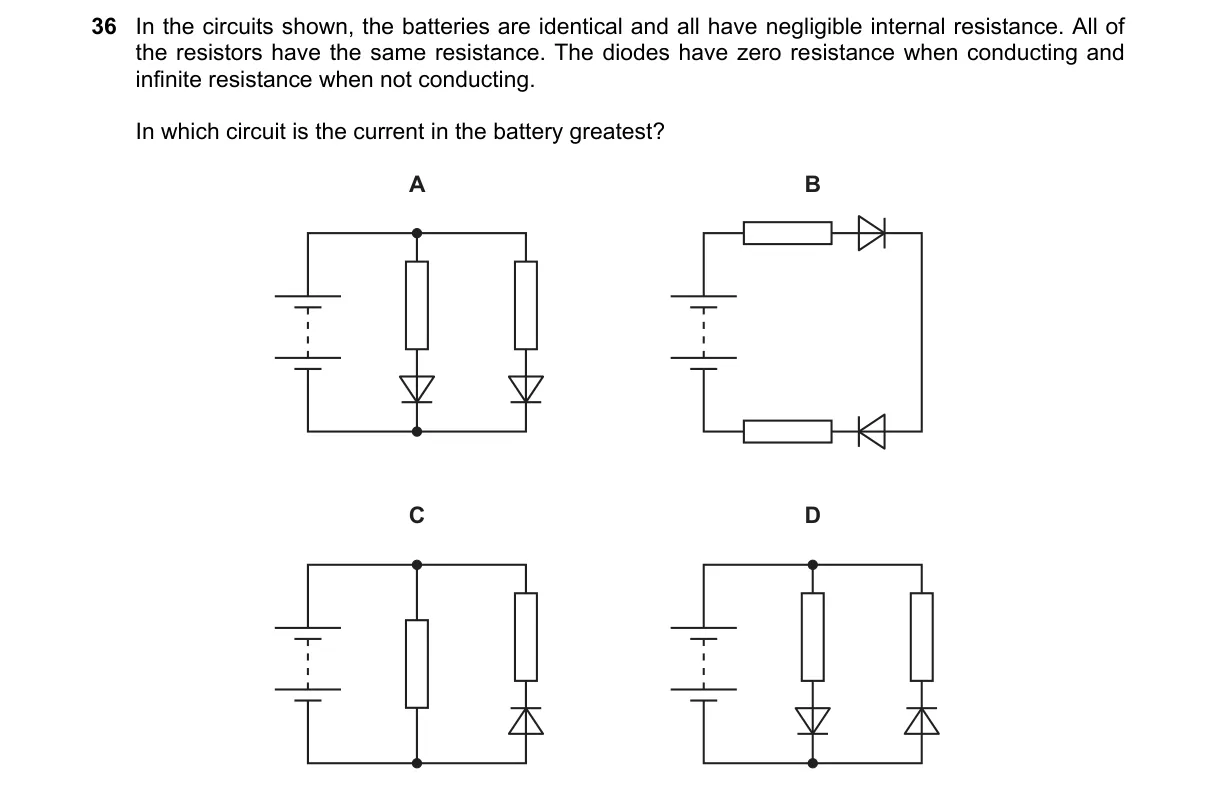
Answer choices
- AOption A
- BOption B
- COption C
- DOption D
Explanation
Diode circuits require diagram analysis for current paths
Steps:
- Identify effective resistance seen by battery in each circuit, considering diode conduction (forward bias closes path with zero resistance, reverse opens it).
- Assume standard configurations: diodes allow current only in one direction, batteries oriented to drive current.
- Calculate total resistance: parallel paths reduce equivalent R, increasing current (I = V/R, V same).
- Compare currents: lowest effective R gives highest I.
Why A is correct:
- Circuit A has most parallel conducting paths through diodes, minimizing equivalent resistance per Ohm's law.
Why the others are wrong:
- B: Fewer conducting paths increase effective R, reducing I.
- C: Series diodes block or limit paths, raising R.
- D: Reverse-biased diodes open more paths, highest R.
Not enough information: Diagrams missing, preventing precise path analysis.
Final answer: A
Topic: Kirchhoff's laws
Practice more A Levels Physics (9702) questions on mMCQ.me