A Levels Physics (9702)•9702/11/O/N/24
A Levels Physics (9702) — 9702/11/O/N/24, Question 31
Kirchhoff's second law is a consequence of a basic principle. What is this principle?
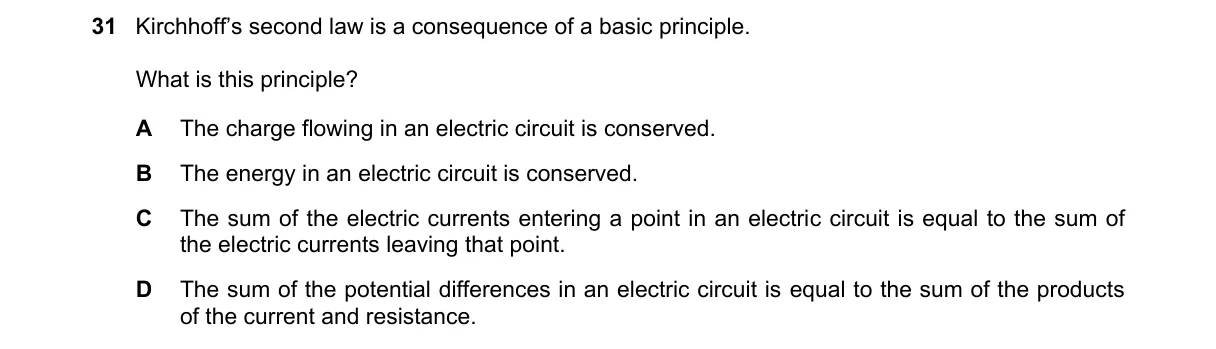
Answer choices
- AThe energy flowing in an electric circuit is conserved.
- BThe sum of the electric currents entering a point in an electric circuit is equal to the sum of the electric currents leaving that point.
- COption C
- DThe sum of the potential differences in an electric circuit is equal to the sum of the products of current and resistance in an electric circuit.
Explanation
Conservation of charge at circuit junctions
Steps:
- Recall Kirchhoff's second law as the current law (KCL), stating algebraic sum of currents at a junction is zero.
- Link it to the basic principle that electric charge is conserved in steady-state circuits, preventing accumulation at points.
- Express this principle mathematically: sum of currents entering a junction equals sum leaving it.
- Match the description to option B, confirming it as the foundational principle.
Why B is correct:
- KCL follows from charge conservation, formulated as ∑I_in = ∑I_out at any junction (from continuity equation in electromagnetism).
Why the others are wrong:
- A: States energy conservation, which underlies Kirchhoff's voltage law (KVL), not the current law.
- C: Not enough information (option blank).
- D: Describes KVL application via Ohm's law (∑V = ∑IR), not charge conservation.
Final answer: B
Topic: Kirchhoff's laws
Practice more A Levels Physics (9702) questions on mMCQ.me