A Levels Physics (9702)•9702/11/O/N/24
A Levels Physics (9702) — 9702/11/O/N/24, Question 29
Radio waves can be polarised, but sound waves cannot be polarised. Which statement gives the reason for this?
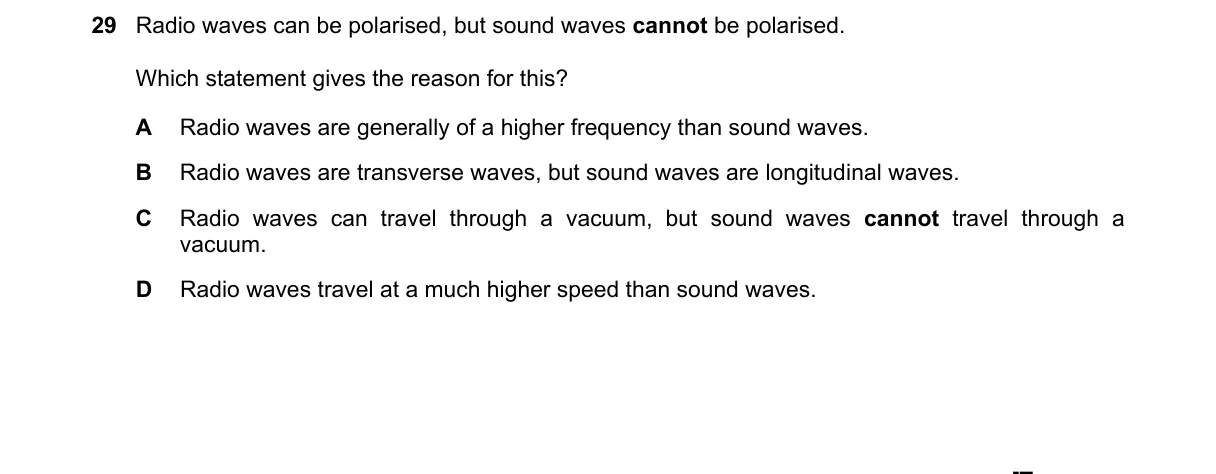
Answer choices
- ARadio waves are generally of a higher frequency than sound waves.
- BRadio waves are transverse waves, but sound waves are longitudinal waves.
- CRadio waves can travel through a vacuum, but sound waves cannot.
- DRadio waves travel at a much higher speed than sound waves.
Explanation
Polarization depends on wave type
Steps:
- Recall that polarization is the orientation of wave oscillations perpendicular to the direction of propagation.
- Identify radio waves as electromagnetic waves, which oscillate transversely (electric and magnetic fields perpendicular to travel).
- Identify sound waves as mechanical waves in air, which oscillate longitudinally (particles move parallel to travel).
- Conclude that only transverse waves allow restriction of oscillation direction, enabling polarization.
Why B is correct:
- Transverse waves have oscillations in a plane that can be aligned or filtered (e.g., by a polarizer), per the definition of polarization in wave physics; longitudinal waves lack this directional variability.
Why the others are wrong:
- A: Frequency affects wavelength but not the ability to polarize, which is structural.
- C: Vacuum travel relates to medium requirements, not oscillation type for polarization.
- D: Speed differences arise from medium and wave nature but do not determine polarizability.
Final answer: B
Topic: Transverse and longitudinal waves
Practice more A Levels Physics (9702) questions on mMCQ.me