A Levels Physics (9702)•9702/11/O/N/24
A Levels Physics (9702) — 9702/11/O/N/24, Question 23
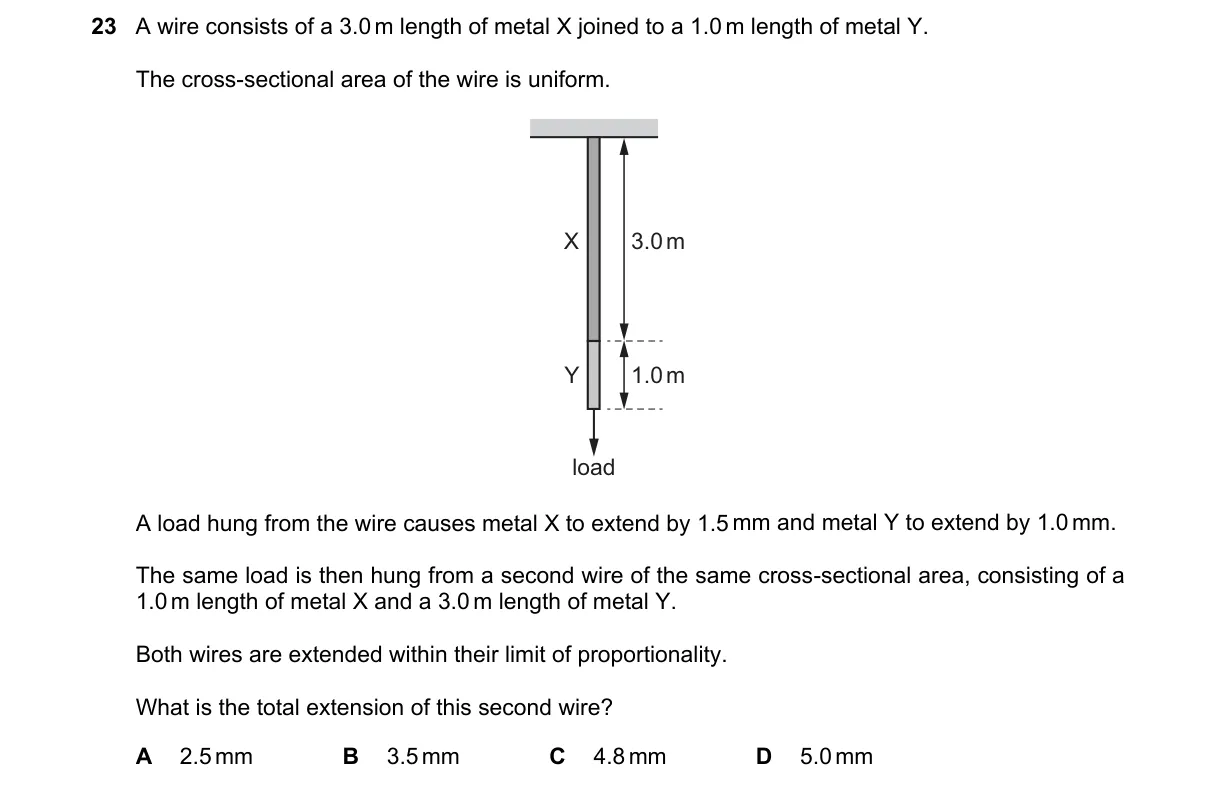
A wire consists of 3.0 m length of metal X joined to 1.0 m length of metal Y. The cross-sectional area of the wire is uniform. A load hung from the wire causes metal X to extend by 1.5 mm and metal Y to extend by 1.0 mm. The same load is then hung from a 1.0 m length of metal X and a 3.0 m length of metal Y, both wires are the same cross-sectional area, consisting of a Both wires are extended within their limit of proportionality. What is the total extension?
Answer choices
- A1.5 mm
- B3.5 mm
- C4.8 mm
- D5.0 mm
Explanation
Extension proportional to length under Hooke's law Steps:
- Calculate extension per unit length for X from first setup: 1.5 mm / 3 m = 0.5 mm/m.
- Calculate extension per unit length for Y from first setup: 1.0 mm / 1 m = 1.0 mm/m.
- For second setup, X extension: 0.5 mm/m × 1 m = 0.5 mm.
- For second setup, Y extension: 1.0 mm/m × 3 m = 3.0 mm; total = 0.5 mm + 3.0 mm = 3.5 mm. Why B is correct:
- Hooke's law: extension δ = (F L)/(A E), so for constant F and A, δ ∝ L, allowing scaling from first setup. Why the others are wrong:
- A: 1.5 mm - Matches only original X extension, ignores Y's contribution.
- C: 4.8 mm - Arises from erroneous ratio like (1.5+1.0)×(3+1)/4, not proportional scaling.
- D: 5.0 mm - Assumes equal extension rates for X and Y, contradicting given data.
Final answer: B
Topic: Stress and strain
Practice more A Levels Physics (9702) questions on mMCQ.me