A Levels Physics (9702)•9702/11/O/N/24
A Levels Physics (9702) — 9702/11/O/N/24, Question 19
A spring of spring constant 30N/m is suspended vertically from the top. The spring obeys Hooke's law. Initially the spring is not compressed and not stretched. A mass of 0.5kg is attached to the bottom of the spring. The mass is released from rest and falls. In the motion that follows, what is the maximum extension of the spring?
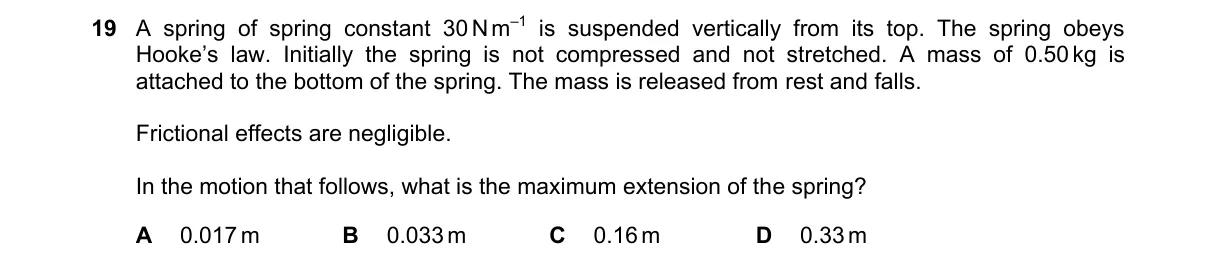
Answer choices
- A0.01m
- B0.03m
- C0.1m
- D0.3m
Explanation
Energy conservation in vertical spring-mass system
Steps:
- At maximum extension δ, velocity is zero; gravitational potential energy loss equals spring potential energy gain.
- Set initial position (unstretched) as gravitational PE zero: mgδ = (1/2)kδ².
- Solve for δ: δ = 2mg/k.
- Substitute m=0.5 kg, g=10 m/s², k=30 N/m: δ = 2(0.5)(10)/30 = 10/30 = 1/3 m ≈ 0.3 m.
Why D is correct:
- D matches δ = 2mg/k from equating energies at release and maximum stretch (Hooke's law and conservation of energy).
Why the others are wrong:
- A is 1/300 of actual δ, possibly confusing k with 3000 N/m.
- B approximates mg/k (equilibrium extension) but ignores full oscillation amplitude.
- C is about 1.5 times mg/k, underestimating the doubling from energy balance.
Final answer: D
Topic: Simple harmonic oscillations
Practice more A Levels Physics (9702) questions on mMCQ.me