A Levels Physics (9702)•9702/11/O/N/24
A Levels Physics (9702) — 9702/11/O/N/24, Question 15
A solid sphere, which is less dense than water, is held completely immersed in water a few metres below surface. The density of the water is uniform. When the sphere is released. Which row describes the changes in the magnitudes of the upthrust on the sphere and the resultant force on the sphere as it rises?
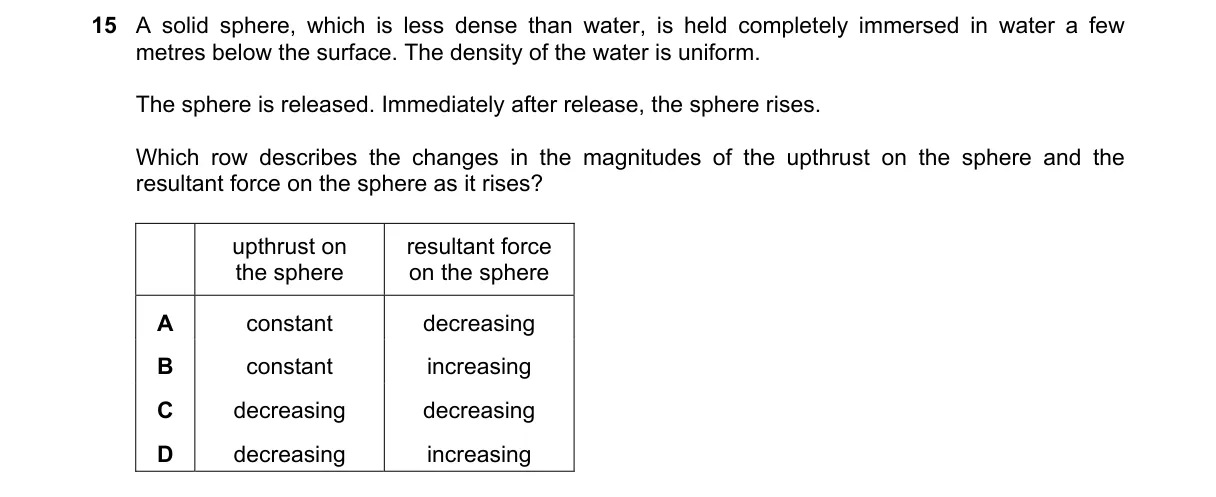
Answer choices
- Aupthrust on the sphere: constant; resultant force on the sphere: decreasing
- Bupthrust on the sphere: constant; resultant force on the sphere: increasing
- Cupthrust on the sphere: decreasing; resultant force on the sphere: decreasing
- Dupthrust on the sphere: decreasing; resultant force on the sphere: increasing
Explanation
Buoyancy and motion in uniform fluid
Steps:
- Upthrust equals weight of displaced water; since sphere is fully immersed and water density is uniform, upthrust remains constant regardless of depth.
- Weight of sphere is constant and less than upthrust, so net upward force (resultant force) is upthrust minus weight.
- As sphere rises, it accelerates upward, gaining speed.
- Increasing speed causes drag force to increase (proportional to speed squared), reducing the net upward resultant force over time.
Why A is correct:
- Upthrust is constant due to Archimedes' principle (displaced volume and fluid density unchanged); resultant force decreases as drag rises with velocity.
Why the others are wrong:
- B: Resultant force decreases, not increases, due to growing drag.
- C: Upthrust does not decrease in uniform density water.
- D: Upthrust is constant, not decreasing.
Final answer: A
Topic: Density and pressure
Practice more A Levels Physics (9702) questions on mMCQ.me