A Levels Physics (9702)•9702/11/O/N/24
A Levels Physics (9702) — 9702/11/O/N/24, Question 10
A lift (elevator) consists of a passenger car supported by a cable that runs over a frictionless pulley to a counterbalance. The counterbalance falls as the passenger car rises. Some masses are shown in the table: passenger car 520 kg, counterbalance 640 kg. What is the magnitude of the acceleration of the car when carrying just one passenger (80 kg) and when the counterbalance falls as the passenger car rises.
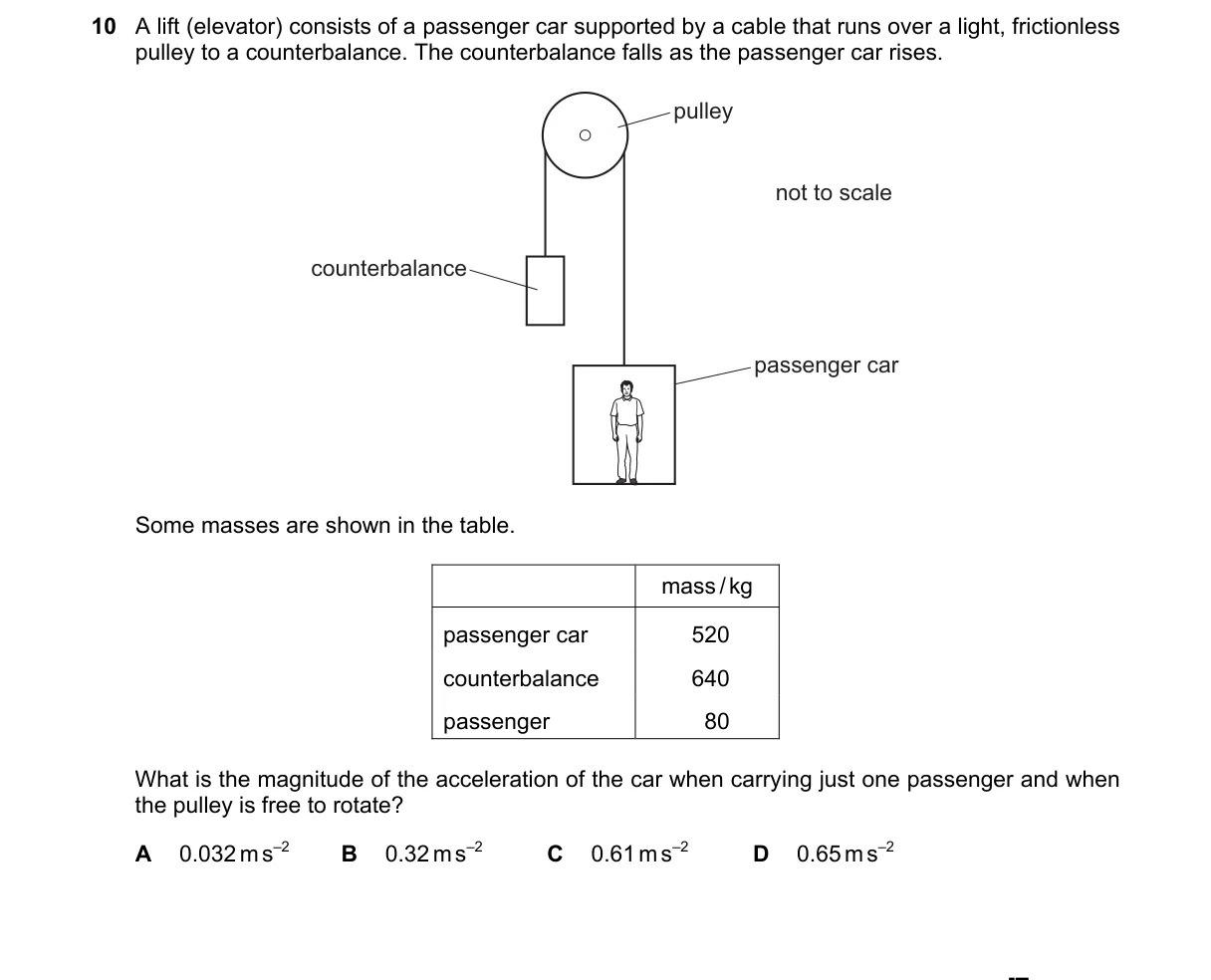
Answer choices
- A0.32 m/s²
- B0.61 m/s²
- C0.65 m/s²
- D0.05 m/s²
Explanation
Atwood's machine acceleration Steps:
- Total mass on car side: passenger car + passenger = 520 kg + 80 kg = 600 kg.
- Counterbalance mass: 640 kg (heavier, so it falls and car rises).
- Net force: (640 kg - 600 kg) × g = 40g (downward on counterbalance side).
- Acceleration: a = net force / total mass = 40g / (600 kg + 640 kg) = 40 × 9.8 / 1240 ≈ 0.32 m/s².
Why A is correct:
- Follows Newton's second law for connected masses over a pulley: a = (m₂ - m₁)g / (m₁ + m₂), where m₂ = 640 kg > m₁ = 600 kg.
Why the others are wrong:
- B: Uses incorrect denominator m₂ only, giving a ≈ (40/640)g = 0.61 m/s² (approximation error for unequal masses).
- C: Might assume counterweight equals car (a ≈ 80g / 1040 ≈ 0.75 m/s², rounded wrongly).
- D: Far too small; perhaps divides by excessive total mass or neglects g.
Final answer: A
Topic: Momentum and Newton's laws of motion
Practice more A Levels Physics (9702) questions on mMCQ.me