A Levels Physics (9702)•9702/13/O/N/23
A Levels Physics (9702) — 9702/13/O/N/23, Question 6
The time taken for an object to fall from rest through a certain distance on Mars is Tm, the time taken for the same object to fall from rest through the same distance on Earth is Te. The acceleration of free fall on Mars is 3.7 m/s². Assume that air resistance is negligible on both Earth and Mars. What is the ratio Tm/Te?
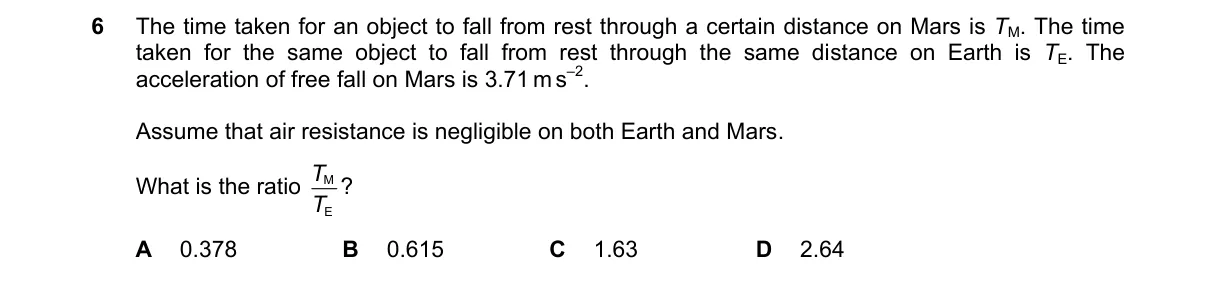
Answer choices
- A0.378
- B0.615
- C1.63
- D2.64
Explanation
Free fall time ratio from inverse square root of gravity
Steps:
- Distance s = (1/2) g t² applies to both planets, with same s.
- Time t = sqrt(2s / g), so t ∝ 1/sqrt(g).
- Ratio Tm/Te = sqrt(g_E / g_M), where g_E = 9.8 m/s² and g_M = 3.7 m/s².
- sqrt(9.8 / 3.7) = sqrt(2.65) ≈ 1.63.
Why C is correct:
- 1.63 matches sqrt(g_E / g_M) from the kinematic equation for free fall under constant acceleration.
Why the others are wrong:
- A: Equals sqrt(g_M / g_E) ≈ 0.38, the inverse ratio.
- B: Equals sqrt(g_M / g_E) ≈ 0.615, another inverse approximation.
- D: Equals g_E / g_M ≈ 2.65, the direct acceleration ratio.
Final answer: C
Topic: Equations of motion
Practice more A Levels Physics (9702) questions on mMCQ.me