A Levels Physics (9702)•9702/13/O/N/23
A Levels Physics (9702) — 9702/13/O/N/23, Question 4
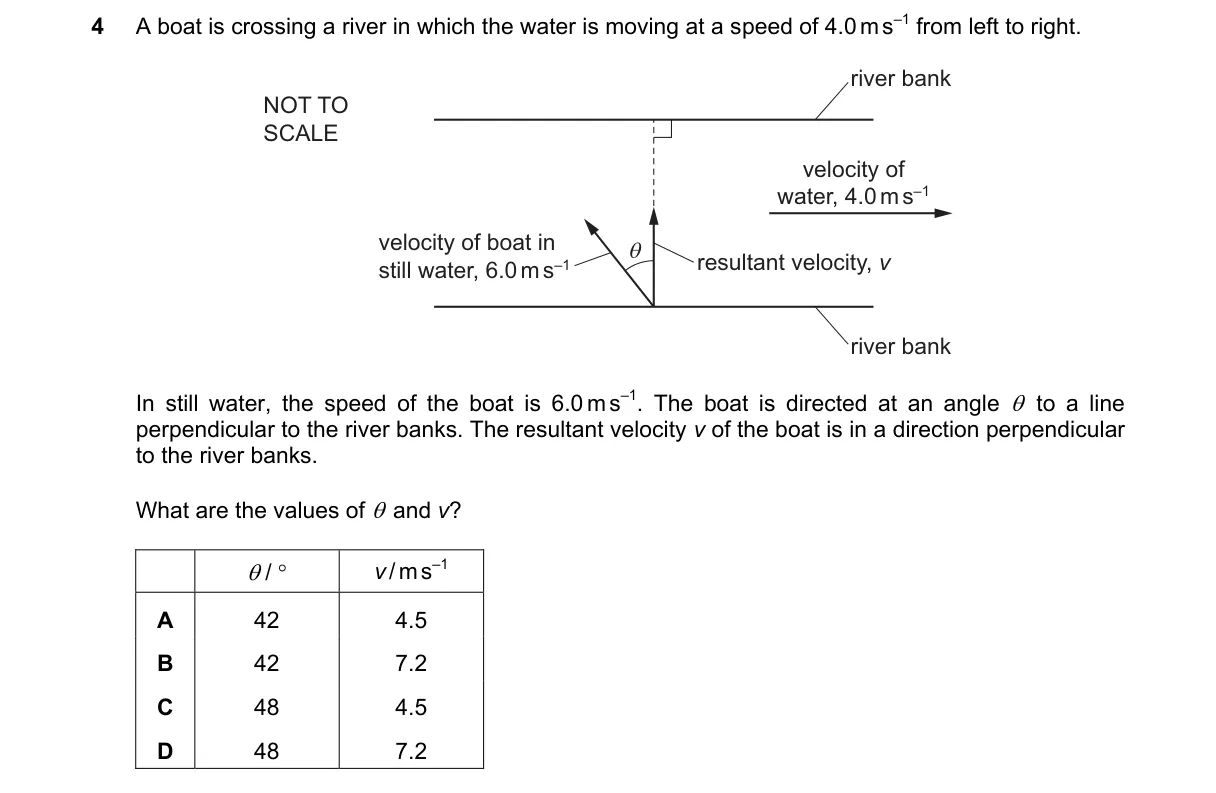
A boat crossing a river in which the water is moving at a speed of 4.0 m/s from left to right. In still water, the speed of the boat is 6.0 m/s. The boat is directed at an angle θ to a line perpendicular to the river banks. The resultant velocity v of the boat is in a direction perpendicular to the river banks. What are the values of θ and v?
Answer choices
- A42° 4.5 m/s
- B42 7.2
- C48 4.5
- D48° 7.2 m/s
Explanation
Vector addition of boat and river current velocities
Steps:
- Boat's velocity components: perpendicular to banks = 6 cos θ m/s; upstream parallel = 6 sin θ m/s.
- For resultant velocity perpendicular to banks, net parallel component = 0: 6 sin θ - 4 = 0 → sin θ = 4/6 = 2/3 → θ = arcsin(2/3) ≈ 42°.
- cos θ = √(1 - sin² θ) = √(1 - 4/9) = √(5/9) = √5 / 3 ≈ 0.745.
- Resultant speed v = perpendicular component = 6 cos θ = 6 × (√5 / 3) = 2√5 ≈ 4.5 m/s.
Why A is correct:
- Matches exact calculation: θ ≈ 42° from sin θ = current/boat speed ratio; v = 4.5 m/s from Pythagorean theorem on components.
Why the others are wrong:
- B: v = 7.2 m/s exceeds boat's maximum speed (6 m/s), ignoring vector cancellation.
- C: θ = 48° from incorrect sin θ = 6/4 (swapped speeds), yielding wrong angle.
- D: Combines C's wrong θ with B's excessive v.
Final answer: A
Topic: Scalars and vectors
Practice more A Levels Physics (9702) questions on mMCQ.me