A Levels Physics (9702) — 9702/13/O/N/23, Question 37
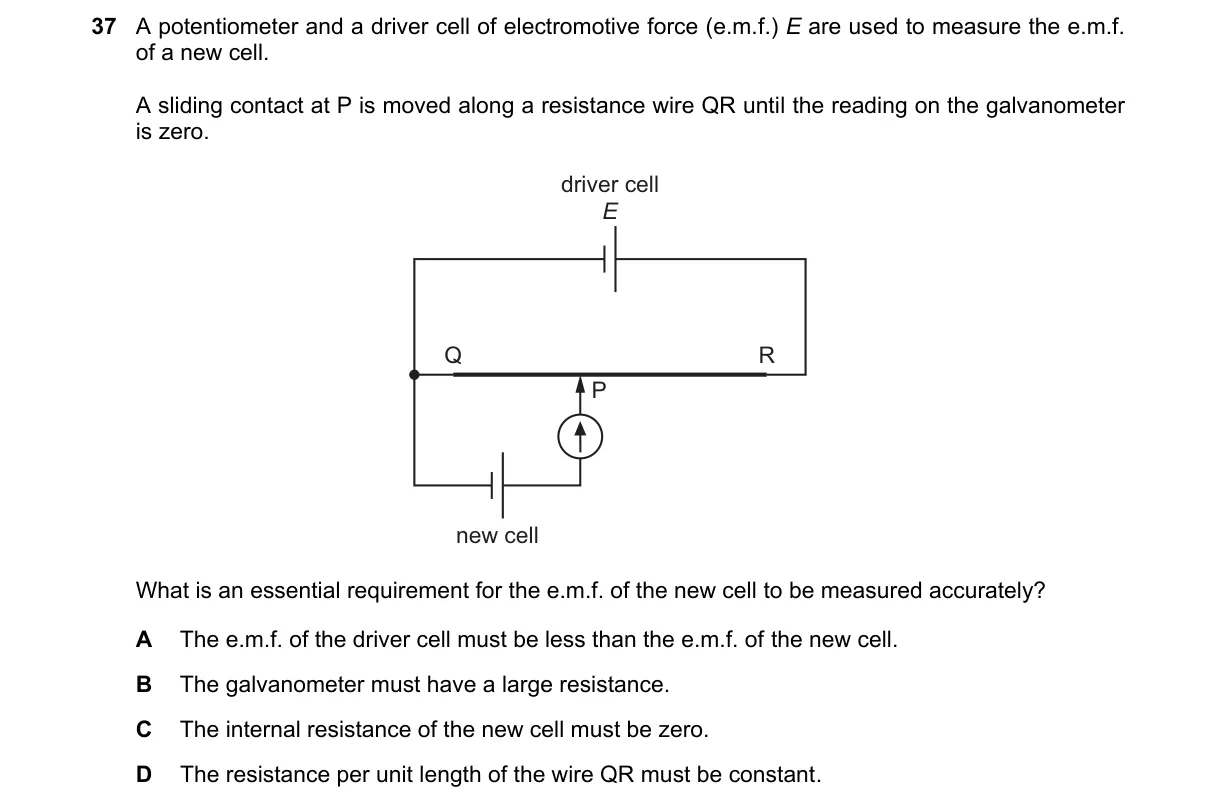
Answer choices
- AThe emf of the driver cell must be larger than the emf of the new cell.
- BThe internal resistance of the new cell must be zero.
- CThe resistance per unit length of the wire QR must be constant.
- DThe galvanometer must have a large resistance.
Explanation
Uniform potential gradient ensures accurate emf measurement Steps: - In a potentiometer, the emf of the new cell equals the potential difference across the wire segment up to the null point. - This PD is given by ε = (E_driver / R_total) * r * l, where r is resistance per unit length and l is length to null point. - For ε to be proportional to l, the potential gradient (E_driver * r / R_total) must be constant along the wire. - Thus, r must be constant for accurate calibration of ε versus l. Why C is correct: - Constant resistance per unit length ensures uniform potential gradient, so emf = k * l holds accurately per Ohm's law (V = IR). Why the others are wrong: - A: Driver emf > new cell emf is needed to find a null point but not for accuracy once found. - B: Potentiometer measures emf without drawing current from the cell, so internal resistance has no effect. - D: Galvanometer resistance does not affect the null condition, as no current flows …
Practice more A Levels Physics (9702) questions on mMCQ.me