A Levels Physics (9702)•9702/13/O/N/23
A Levels Physics (9702) — 9702/13/O/N/23, Question 35
Three resistors, R1, R2 and R3 are connected in parallel to a cell. The currents in the resistors are I1, I2, I3. The potential difference across the cell is V, and the potential differences across the resistors are V1, V2, V3. The current in the cell is I. Which equation can be obtained by applying Kirchhoff's second law to the circuit?
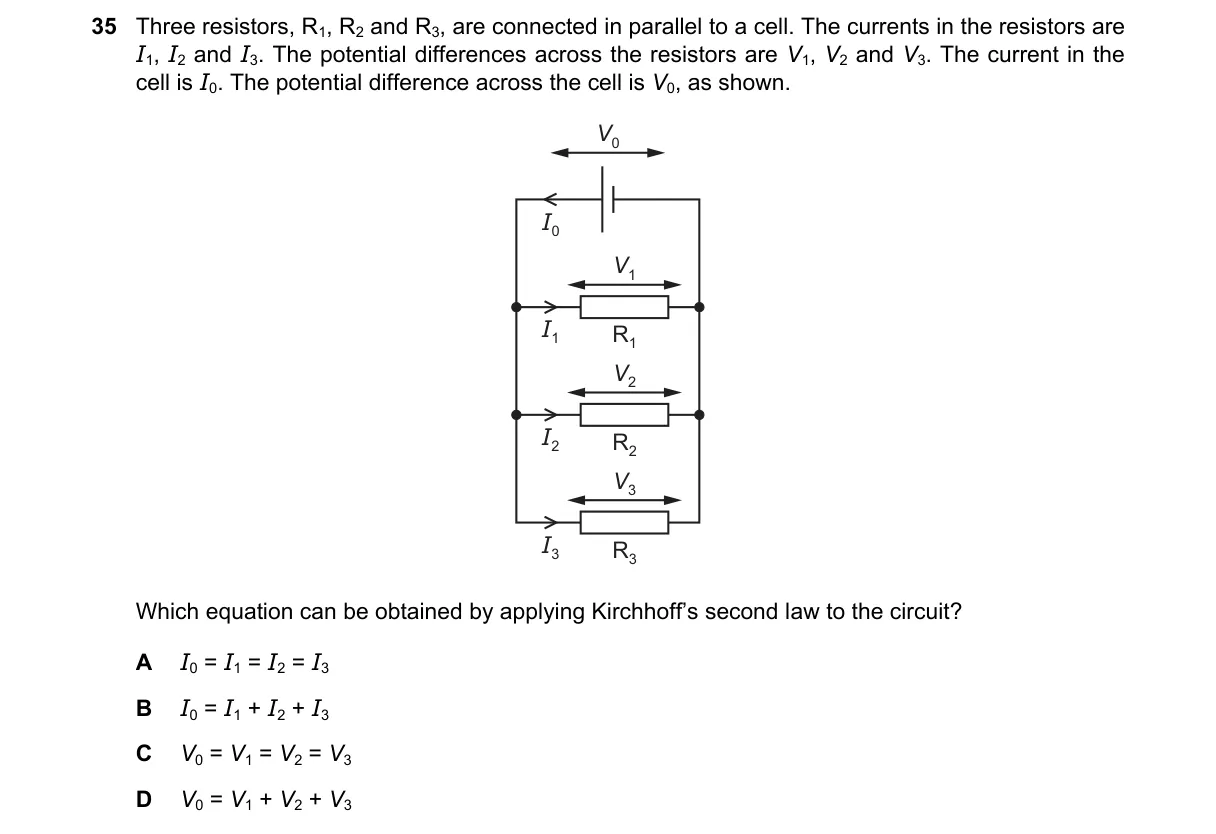
Answer choices
- AI = I1 + I2 + I3
- BV = V1 + V2 + V3
- CV2 = V1 + V3
- DV = V1 = V2 = V3
Explanation
Kirchhoff's Voltage Law in Parallel Circuits
Steps:
- Identify the circuit: Resistors R1, R2, R3 in parallel across cell with emf V, so each branch shares the same potential difference.
- Apply Kirchhoff's second law (KVL): Sum of voltages in any closed loop equals zero.
- Consider a loop through the cell and one resistor, e.g., cell to R1: +V - V1 = 0, so V = V1.
- Repeat for other branches: V = V2 and V = V3, yielding V = V1 = V2 = V3.
Why D is correct:
- In parallel circuits, KVL requires the cell's emf V equals the voltage drop across each resistor, as each forms a loop where V - Vi = 0.
Why the others are wrong:
- A: This is Kirchhoff's first law (current law) for currents at the junction.
- B: This applies to series circuits, where voltages add up.
- C: This implies V2 exceeds the others, violating equal voltages in parallel.
Final answer: D
Topic: Kirchhoff's laws
Practice more A Levels Physics (9702) questions on mMCQ.me