A Levels Physics (9702)•9702/13/O/N/23
A Levels Physics (9702) — 9702/13/O/N/23, Question 33
A battery of electromotive force (emf) 12V and negligible internal resistance is connected to a fixed resistor of resistance 40Ω and a thermistor of resistance R, as shown. Initially, the temperature of the thermistor is 15°C and the current in the circuit is 0.10A. The temperature of the thermistor then changes, which causes the current to increase to 0.12A. How does the temperature of the thermistor change and what is R at the new temperature?
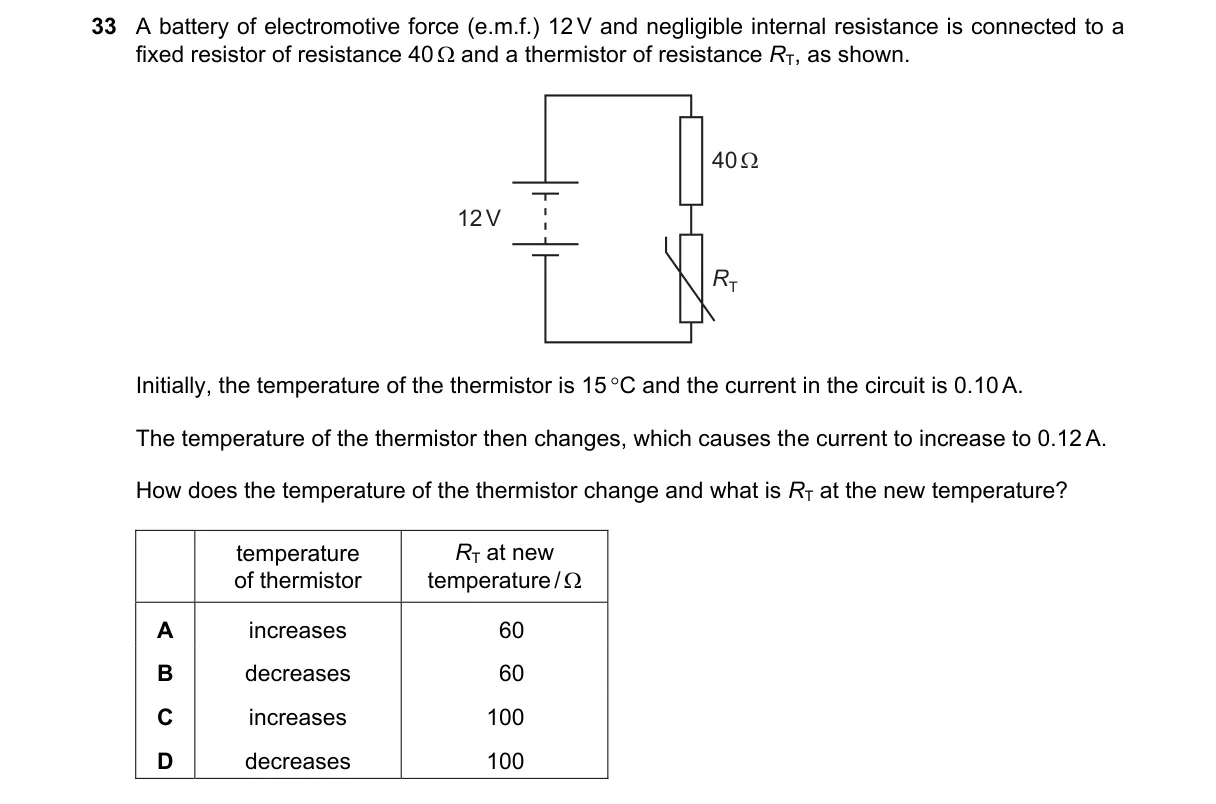
Answer choices
- Atemperature of thermistor increases 60Ω
- Bdecreases 60
- Cdecreases 100
- Dincreases 100
Explanation
Thermistor resistance decreases with increasing temperature (NTC type)
Steps:
- Initial total resistance: 12V / 0.10A = 120Ω, so initial R = 120Ω - 40Ω = 80Ω.
- New total resistance: 12V / 0.12A = 100Ω, so new R = 100Ω - 40Ω = 60Ω.
- Resistance drops from 80Ω to 60Ω, indicating temperature increase for NTC thermistor.
- New resistance is 60Ω at higher temperature.
Why A is correct:
- NTC thermistors follow the principle that resistance decreases as temperature rises, matching the observed current increase and R=60Ω.
Why the others are wrong:
- B: Temperature decreases would increase resistance for NTC, but resistance fell.
- C: 100Ω exceeds initial 80Ω, implying resistance rise inconsistent with current increase.
- D: Temperature increase with R=100Ω wrongly suggests resistance rise, opposite of NTC behavior.
Final answer: A
Topic: Practical circuits
Practice more A Levels Physics (9702) questions on mMCQ.me