A Levels Physics (9702)•9702/13/O/N/23
A Levels Physics (9702) — 9702/13/O/N/23, Question 31
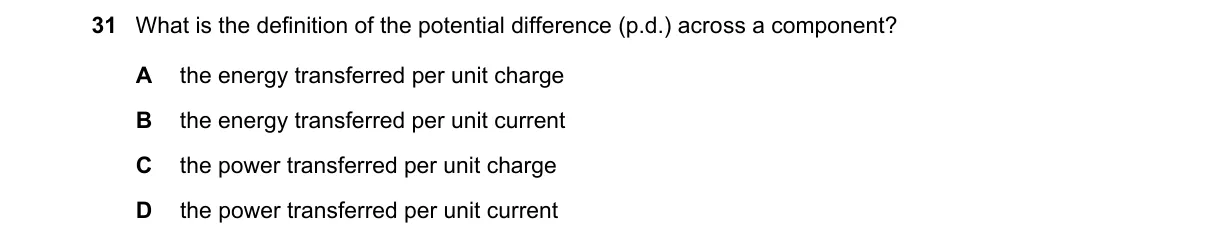
What is the definition of the potential difference (p.d.) across a component?
Answer choices
- Athe energy transferred per unit charge
- Bthe power transferred per unit current
- Cthe energy transferred per unit current
- Dthe power transferred per unit charge
Explanation
Potential Difference as Energy per Unit Charge
Steps:
- Recall that potential difference (p.d.) measures the work done to move a unit charge between two points.
- Express this as p.d. = energy transferred / charge, or V = W / Q.
- Compare to options: A matches energy per unit charge directly.
- Eliminate mismatches: B, C, D involve power or current, not the core definition.
Why A is correct:
- By definition, p.d. is the energy transferred per unit charge, as in the formula V = W / Q, where V is volts, W is joules, and Q is coulombs.
Why the others are wrong:
- B: Power per unit current equals resistance (P = I²R), not p.d.
- C: Energy per unit current lacks charge basis; it's not a standard definition.
- D: Power per unit charge relates to electric field strength, not p.d.
Final answer: A
Topic: Potential difference and power
Practice more A Levels Physics (9702) questions on mMCQ.me