A Levels Physics (9702)•9702/13/O/N/23
A Levels Physics (9702) — 9702/13/O/N/23, Question 12
Two parts of a sailing rig. The mast is a vertical rigid beam and the boom. One end of the boom is attached to the mast by a pivot. The other end of the boom is connected to the mast by a rope, as shown. The rope is at an angle of 40° to the horizontal and exerts a tension force T on the boom. The weight of the boom is 200N uniformly distributed along its length. The boom is in equilibrium. What is the tension T?
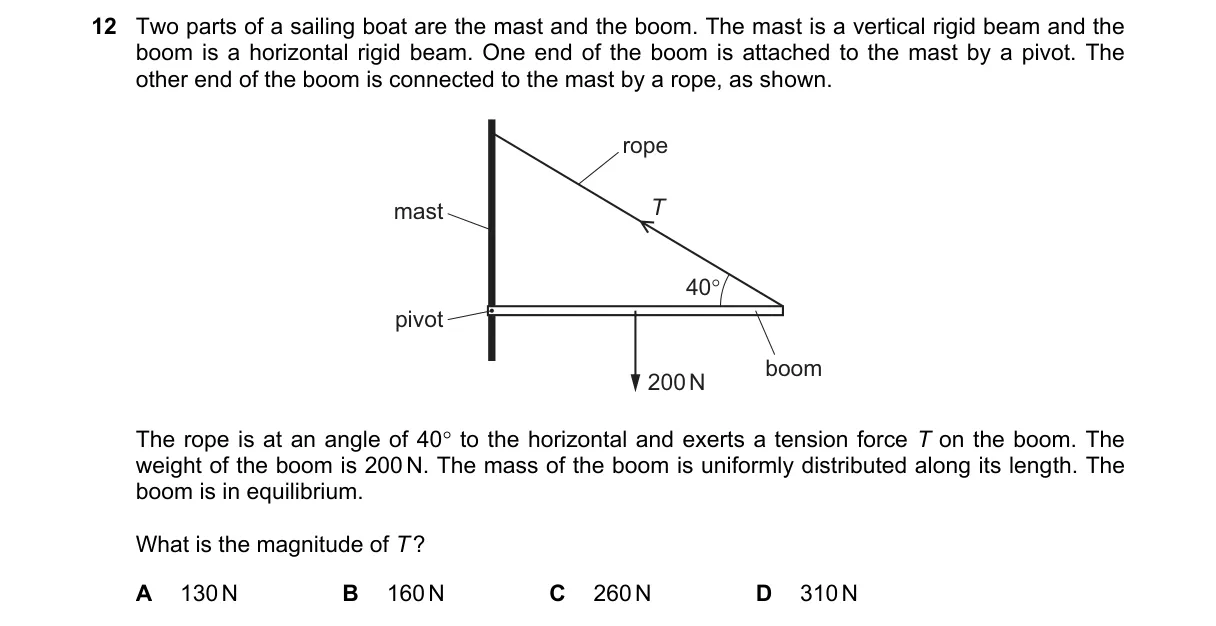
Answer choices
- A130N
- B160N
- C200N
- D310N
Explanation
Torque equilibrium about the pivot
Steps:
- Model boom as horizontal rod of length L, pivoted at mast end.
- Weight of 200 N acts at midpoint, producing clockwise torque of 200 × (L/2) = 100L Nm.
- Tension T acts at far end along rope at 40° to horizontal, so perpendicular component T sin 40° produces counterclockwise torque of T sin 40° × L.
- For rotational equilibrium, torques balance: T sin 40° × L = 100L, so T = 100 / sin 40°.
- Using sin 40° ≈ 0.625, T = 100 / 0.625 = 160 N.
Why B is correct:
- Matches torque balance formula where T provides the exact moment to counter the boom's weight torque.
Why the others are wrong:
- A: Underestimates by using cos 40° (≈0.766) in place of sin 40°, giving ≈130 N.
- C: Equals total weight, ignoring lever arm and angle effects.
- D: Overestimates by considering full vertical support without torque reduction by sin 40°.
Final answer: B
Topic: Turning effects of forces
Practice more A Levels Physics (9702) questions on mMCQ.me