A Levels Physics (9702)•9702/13/O/N/23
A Levels Physics (9702) — 9702/13/O/N/23, Question 10
An object of mass 3.0 kg travelling in a straight line at constant velocity of 3.0 m/s on a horizontal frictionless surface collides with a stationary object Y of mass 0.50 kg. After the collision, object X moves with a velocity of 2.0 m/s at an angle of 41° to the direction of X before the collision, as shown. Object Y moves with a velocity v at an angle of 60° to the direction of X before the collision, as shown. What is the value of v after collision
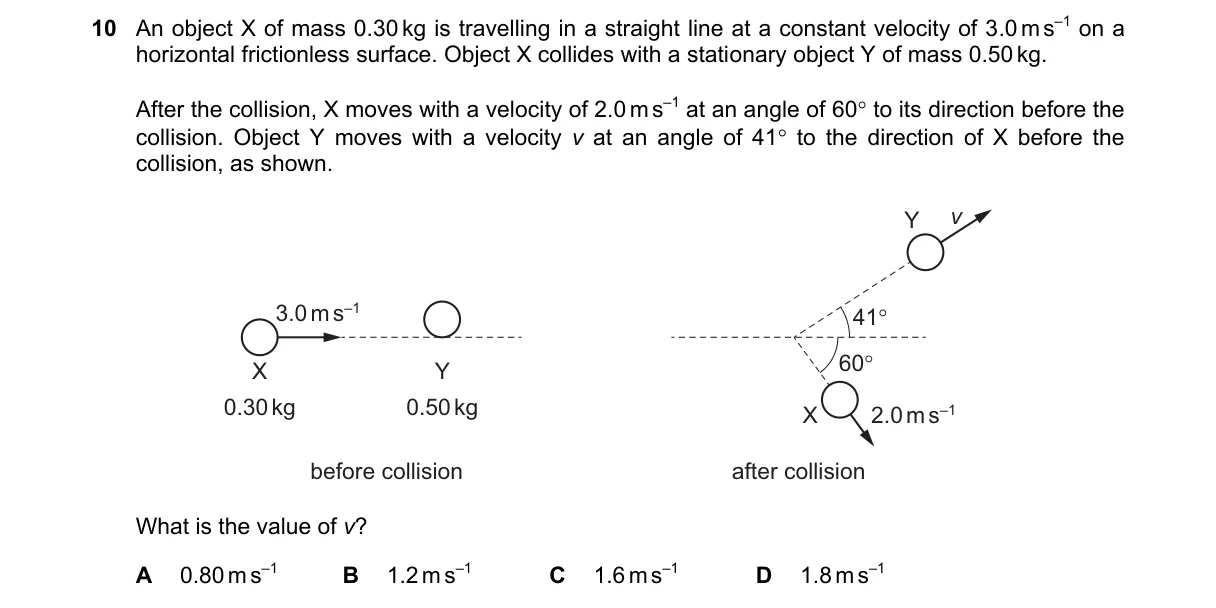
Answer choices
- A0.8 m/s
- B1.2 m/s
- C1.5 m/s
- D1.8 m/s
Explanation
Conservation of momentum in the perpendicular direction
Steps:
- Initial momentum perpendicular to the initial path is zero for both objects.
- After collision, X's perpendicular velocity component is 2.0 × sin 41° ≈ 1.31 m/s.
- Y's perpendicular velocity component is v × sin 60° ≈ v × 0.866 in the opposite direction.
- Momentum conservation requires the perpendicular velocity components to balance in magnitude: v × sin 60° = 2.0 × sin 41°.
- Solve for v: v = 2.0 × (sin 41° / sin 60°) ≈ 2.0 × 0.757 ≈ 1.5 m/s.
Why C is correct:
- It matches the calculation from balancing perpendicular velocity components using the conservation of momentum law, where y-momenta sum to zero.
Why the others are wrong:
- A: Too low; underestimates the ratio of sines (0.656/0.866 ≈ 0.757, times 2.0 gives 1.5, not 0.8).
- B: Too low; ignores the full sine ratio, yielding ~1.2 instead of 1.5.
- D: Too high; overestimates by adding extra factors not in the perpendicular balance.
Final answer: C
Topic: Linear momentum and its conservation
Practice more A Levels Physics (9702) questions on mMCQ.me