A Levels Physics (9702)•9702/12/O/N/23
A Levels Physics (9702) — 9702/12/O/N/23, Question 7
Two blocks, of mass 0.20 kg and 0.50 kg, are connected by a light inextensible string that passes over a frictionless pulley. The blocks are initially held stationary. The block of mass 0.20 kg rests on a rough horizontal surface. The block of mass 0.50 kg is suspended in air. Air resistance is negligible. When the blocks are released, they have an acceleration of magnitude 2.0 m/s². What is the magnitude of the frictional force between the block of mass 0.20 kg and the rough surface?
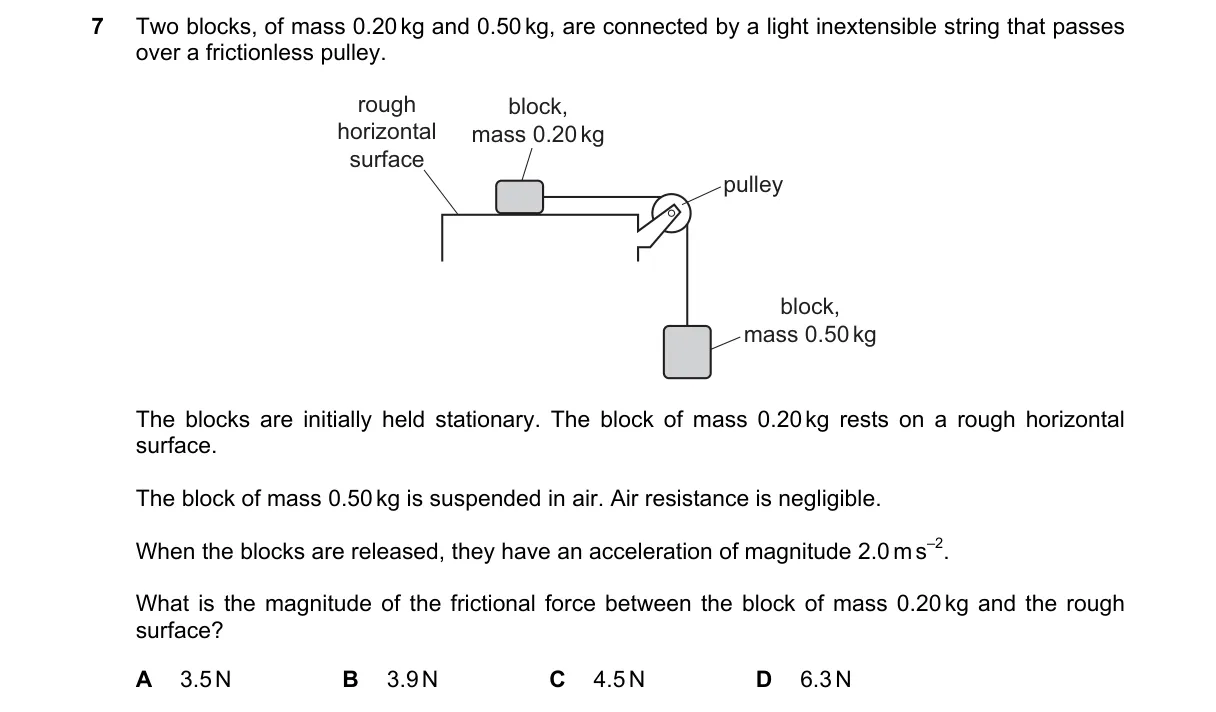
Answer choices
- A0.5 N
- B3.9 N
- C4.5 N
- D6.3 N
Explanation
Net force from hanging weight minus friction drives system acceleration Steps:
- Identify hanging mass m₂ = 0.20 kg and surface mass m₁ = 0.50 kg; motion occurs as hanging block descends if m₂g > f.
- Apply Newton's second law to system: m₂g - f = (m₁ + m₂)a.
- Substitute values with g = 9.8 m/s² and a = 2.0 m/s²: 0.20 × 9.8 - f = (0.70) × 2.0.
- Solve: 1.96 - f = 1.40, so f = 1.96 - 1.40 = 0.56 N ≈ 0.5 N.
Why A is correct:
- Matches f = m₂g - (m₁ + m₂)a from Newton's second law for the system, yielding ≈0.5 N.
Why the others are wrong:
- B is tension T ≈ m₂(g + a) = 0.20 × 11.8 ≈ 2.4 N, not friction.
- C approximates m₁g / 10 or similar misapplication, unrelated to net force.
- D is m₁g - m₁a ≈ 0.50 × 7.8 = 3.9 N, confusing surface normal force with friction.
Final answer: A
Topic: Momentum and Newton's laws of motion
Practice more A Levels Physics (9702) questions on mMCQ.me