A Levels Physics (9702)•9702/12/O/N/23
A Levels Physics (9702) — 9702/12/O/N/23, Question 32
The potential difference across a wire is kept constant. Length and diameter of the wire are both varied. Type of metal is kept the same. How is the current in the wire related to l and d?
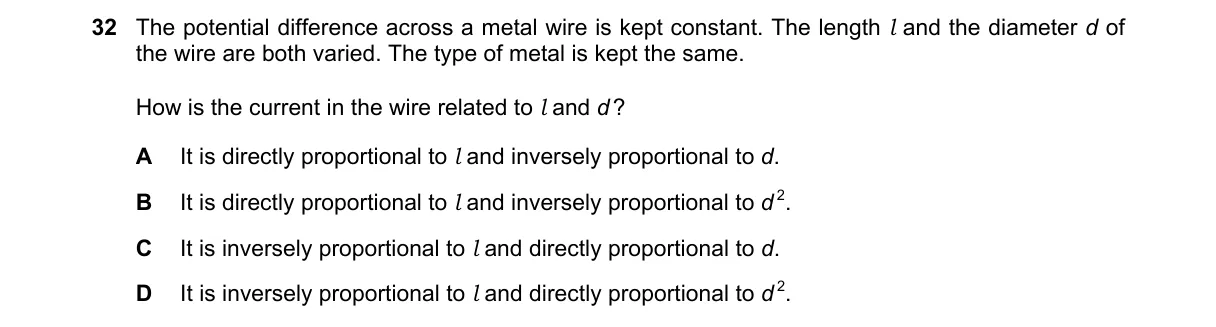
Answer choices
- AIt is directly proportional to l and inversely proportional to d
- BIt is directly proportional to l and inversely proportional to d²
- CIt is inversely proportional to l and directly proportional to d
- DIt is inversely proportional to l and directly proportional to d²
Explanation
Ohm's Law and Wire Resistance
Steps:
- Ohm's law states V = IR; with V constant, I ∝ 1/R.
- Resistance R = ρl / A, where ρ is resistivity (constant for same metal) and A is cross-sectional area.
- Area A = π(d/2)² ∝ d².
- Thus, R ∝ l / d², so I ∝ d² / l.
Why D is correct:
- D states I is inversely proportional to l and directly to d², matching I ∝ d² / l from the resistance formula R = ρl / A with A ∝ d².
Why the others are wrong:
- A: Current decreases with l (inversely), not increases (directly).
- B: Current decreases with l (inversely), not increases (directly).
- C: Current increases with d² (directly), not d (directly).
Final answer: D