A Levels Physics (9702)•9702/12/O/N/23
A Levels Physics (9702) — 9702/12/O/N/23, Question 23
A student is investigating two electromagnetic waves, X and Y, in vacuum. Wave X has wavelength of 5.0 × 10^{-7} m. Wave Y has frequency of 9 GHz. Which principal regions of the electromagnetic spectrum contain waves X and Y
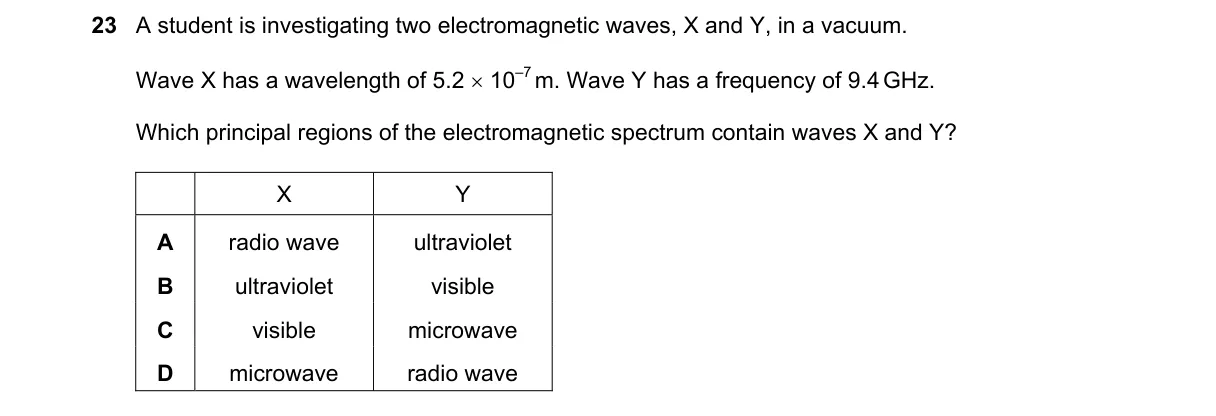
Answer choices
- AX radio wave Y ultraviolet
- BX ultraviolet Y visible
- CX visible Y microwave
- DX microwave Y radio wave
Explanation
Classifying EM waves by wavelength and frequency ranges
Steps:
- Wave X wavelength is 5.0 × 10^{-7} m (500 nm), matching visible light (400–700 nm).
- Wave Y frequency is 9 GHz (9 × 10^9 Hz), falling in microwave range (0.3–300 GHz).
- Compare to spectrum: visible for X, microwave for Y.
- Match to options: C states X visible, Y microwave.
Why C is correct:
- Visible light spans 400–700 nm wavelengths; microwaves span 0.3–300 GHz frequencies, directly placing X and Y there.
Why the others are wrong:
- A: X is not radio (longer wavelengths >1 mm); Y not ultraviolet (higher frequencies >10^{15} Hz).
- B: X not ultraviolet (shorter wavelengths <400 nm); Y not visible (frequencies 4–7.5 × 10^{14} Hz).
- D: X not microwave (longer wavelengths 1 mm–1 m); Y not radio (lower frequencies <300 MHz).
Final answer: C
Topic: Electromagnetic spectrum
Practice more A Levels Physics (9702) questions on mMCQ.me