A Levels Physics (9702)•9702/11/O/N/23
A Levels Physics (9702) — 9702/11/O/N/23, Question 29
A beam of red light of wavelength 720 nm is incident normally on a diffraction grating and produces a diffraction pattern on a screen placed parallel to the grating. The beam of red light is replaced with a beam of electromagnetic radiation of wavelength X. The third-order maximum for electromagnetic radiation of wavelength X is at the same position on the screen as the second-order maximum for the red light.
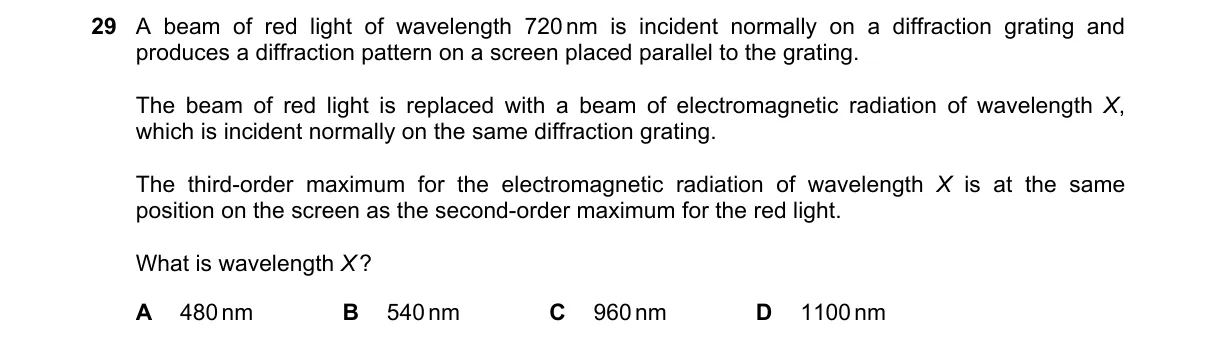
Answer choices
- A480 nm
- B540 nm
- C960 nm
- D1100 nm
Explanation
Diffraction grating equation equates maxima positions
Steps:
- Grating equation: d sinθ = mλ, where d is slit spacing, θ is angle, m is order, λ is wavelength.
- For red light (λ = 720 nm), second-order maximum: d sinθ = 2 × 720 nm.
- For wavelength X, third-order maximum at same θ: d sinθ = 3X.
- Equate: 2 × 720 = 3X → X = 1440 / 3 = 480 nm.
Why A is correct:
- 480 nm satisfies the grating equation d sinθ = mλ for equal θ between second-order red and third-order X.
Why the others are wrong:
- B: 540 nm gives 3 × 540 = 1620 nm, exceeding 1440 nm from red light equation.
- C: 960 nm gives 3 × 960 = 2880 nm, twice the required value.
- D: 1100 nm gives 3 × 1100 = 3300 nm, far larger than 1440 nm.
Final answer: A
Topic: The diffraction grating
Practice more A Levels Physics (9702) questions on mMCQ.me