A Levels Physics (9702)•9702/11/O/N/23
A Levels Physics (9702) — 9702/11/O/N/23, Question 28
Light of wavelength λ is emitted from two point sources R and S and falls on a distant screen. At P on the screen, the light intensity is zero. What could explain the zero intensity at P?
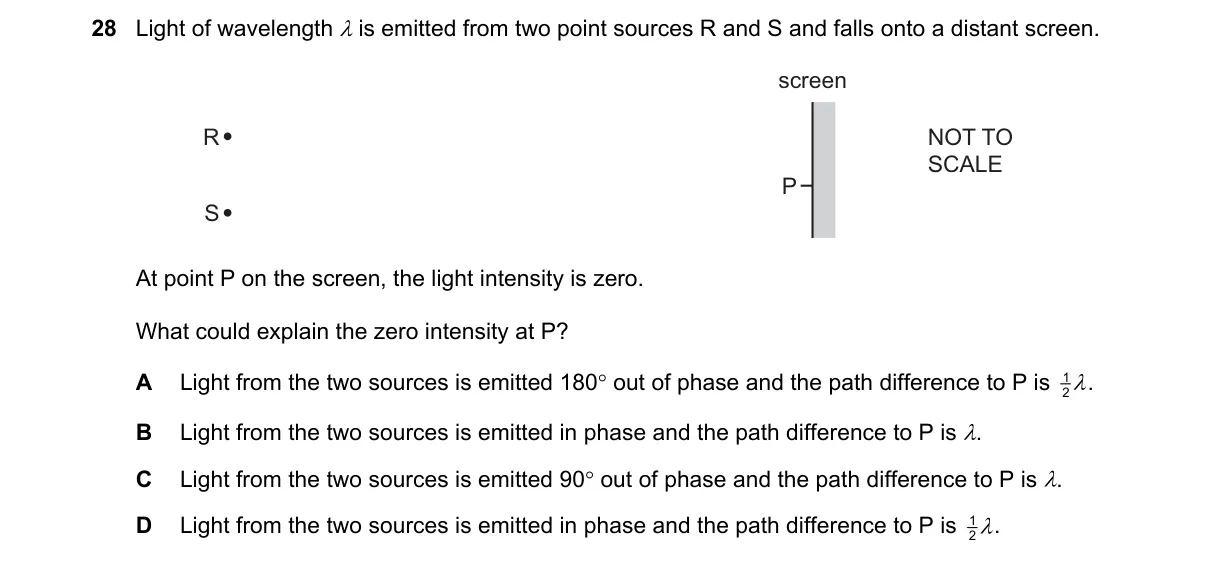
Answer choices
- ALight from the two sources is emitted 180° out of phase and the path difference to P is λ/2.
- BLight from the two sources is emitted in phase and the path difference to P is λ/2.
- CLight from the two sources is emitted 90° out of phase and the path difference to P is λ.
- DLight from the two sources is emitted in phase and the path difference to P is λ/2.
Explanation
Destructive Interference Condition Steps:
- Zero intensity requires destructive interference, where waves arrive with phase difference of (2n+1)π radians.
- Phase difference from path is (2π/λ) × Δpath; for n=0, Δpath = λ/2 gives π radians.
- If sources emit in phase, initial phase difference is 0, so Δpath = λ/2 yields total π for destructive interference.
- Other initial phases or path differences alter total phase, preventing exact destructive interference.
Why D is correct:
- Sources in phase mean initial phase difference of 0; path difference λ/2 adds π radians, satisfying the condition for destructive interference per wave superposition.
Why the others are wrong:
- A: 180° (π radians) initial plus λ/2 path (π radians) totals 2π, causing constructive interference.
- B: Sources in phase with path difference λ adds 2π radians, resulting in constructive interference.
- C: 90° (π/2 radians) initial plus λ path (2π radians) totals 5π/2 ≡ π/2 mod 2π, yielding partial interference, not zero intensity.
Final answer: D
Topic: Interference
Practice more A Levels Physics (9702) questions on mMCQ.me