A Levels Physics (9702)•9702/11/O/N/23
A Levels Physics (9702) — 9702/11/O/N/23, Question 13
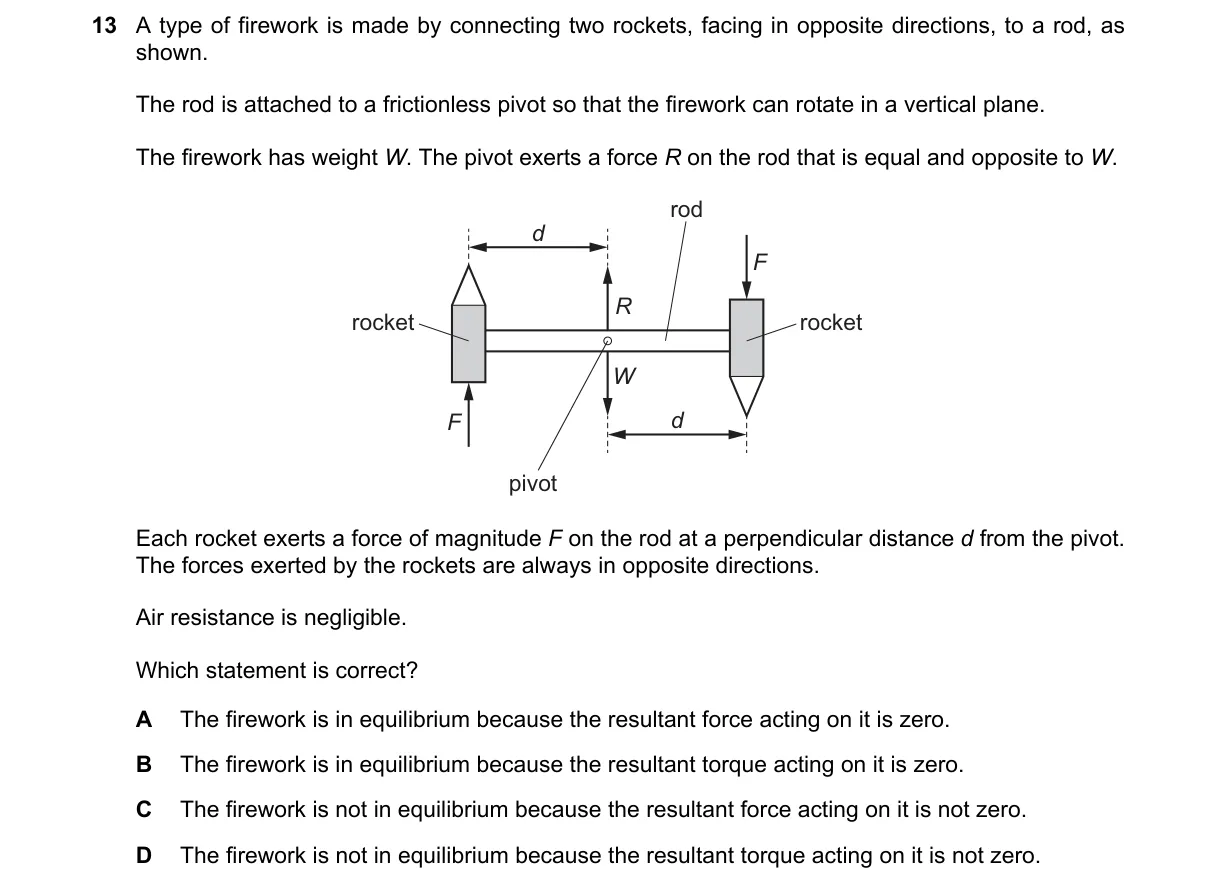
A type of firework is made by connecting two rockets facing opposite directions to a rod, as shown. The rod is attached to a frictionless pivot so that the firework can rotate in a vertical plane. The firework has weight W. The pivot exerts a force R on the rod that is equal and opposite to W. Each rocket exerts a force F on the rod at perpendicular distance d from the pivot. The forces exerted by the rockets are magnitude F on the rod at perpendicular distance d from the pivot. Air resistance is negligible. Which statement is correct?
Answer choices
- AThe firework is in equilibrium because the resultant force acting on it is zero.
- BThe firework is not in equilibrium because the resultant force acting on it is zero.
- CThe firework is not in equilibrium because the resultant torque acting on it is zero.
- DThe firework is not in equilibrium because the resultant force acting on it is not zero.
Explanation
Unbalanced rocket thrusts cause net nonzero force
Steps:
- Weight W acts downward; pivot exerts R upward equal to W, balancing vertical forces.
- Each rocket exerts force F on the rod at perpendicular distance d from pivot.
- Rockets face opposite directions, so their forces F act in the same linear direction on the rod, producing net force 2F.
- Net force is nonzero, so firework accelerates linearly and is not in equilibrium.
Why D is correct:
- For rotational-translational equilibrium, net force must be zero (Newton's first law); here, unbalanced rocket forces give nonzero resultant force.
Why the others are wrong:
- A: Firework not in equilibrium; net force nonzero prevents it despite any torque consideration.
- B: Firework not in equilibrium, but not because net force is zero—it's nonzero.
- C: Torque may be nonzero, but lack of equilibrium stems from nonzero net force, not zero torque.
Final answer: D
Topic: Turning effects of forces
Practice more A Levels Physics (9702) questions on mMCQ.me