A Levels Physics (9702)•9702/13/O/N/22
A Levels Physics (9702) — 9702/13/O/N/22, Question 39
A nucleus X undergoes β⁻ decay. The products are a nucleus with proton number Z, a β⁻ particle and another particle P. X → Y + β⁻ + P What is particle P and what is the proton number of nucleus Y?
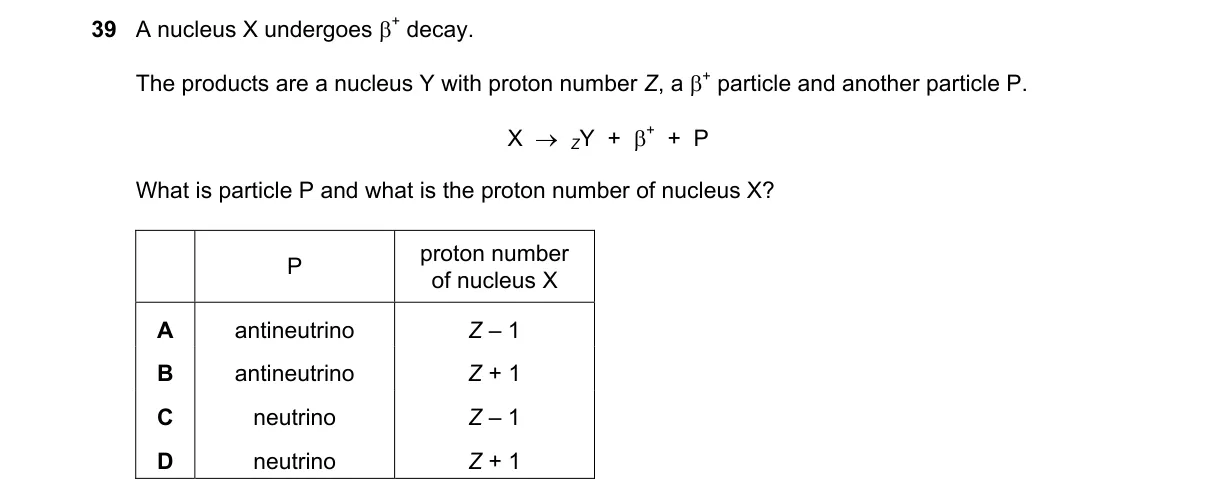
Answer choices
- Aantineutrino Z-1
- Bantineutrino Z+1
- Cneutrino Z-1
- Dneutrino Z+1
Explanation
β⁻ Decay Increases Proton Number and Emits Antineutrino
Steps:
- Nucleus X has proton number Z and undergoes β⁻ decay, where a neutron converts to a proton.
- This increases the proton number of daughter nucleus Y to Z + 1.
- A β⁻ particle (electron) is emitted to balance charge.
- An antineutrino is emitted as particle P to conserve lepton number, energy, and momentum.
Why B is correct:
- In β⁻ decay, the process n → p + e⁻ + \bar{\nu}_e results in Y having Z + 1 protons and P as the antineutrino.
Why the others are wrong:
- A: Proton number of Y is Z + 1, not Z - 1 (which applies to β⁺ decay).
- C: P is antineutrino, not neutrino; Z - 1 is incorrect for Y.
- D: P is antineutrino, not neutrino.
Final answer: B
Topic: Radioactive decay
Practice more A Levels Physics (9702) questions on mMCQ.me