A Levels Physics (9702)•9702/13/O/N/22
A Levels Physics (9702) — 9702/13/O/N/22, Question 31
A battery with a constant internal resistance is connected to a resistor of resistance 250Ω, as shown. The current in the resistor is 0.40mA for a time of 60s. During this time 0.60J of energy is dissipated by the internal resistance. What is the energy supplied by the battery to the external resistor during the 60s and electromotive force
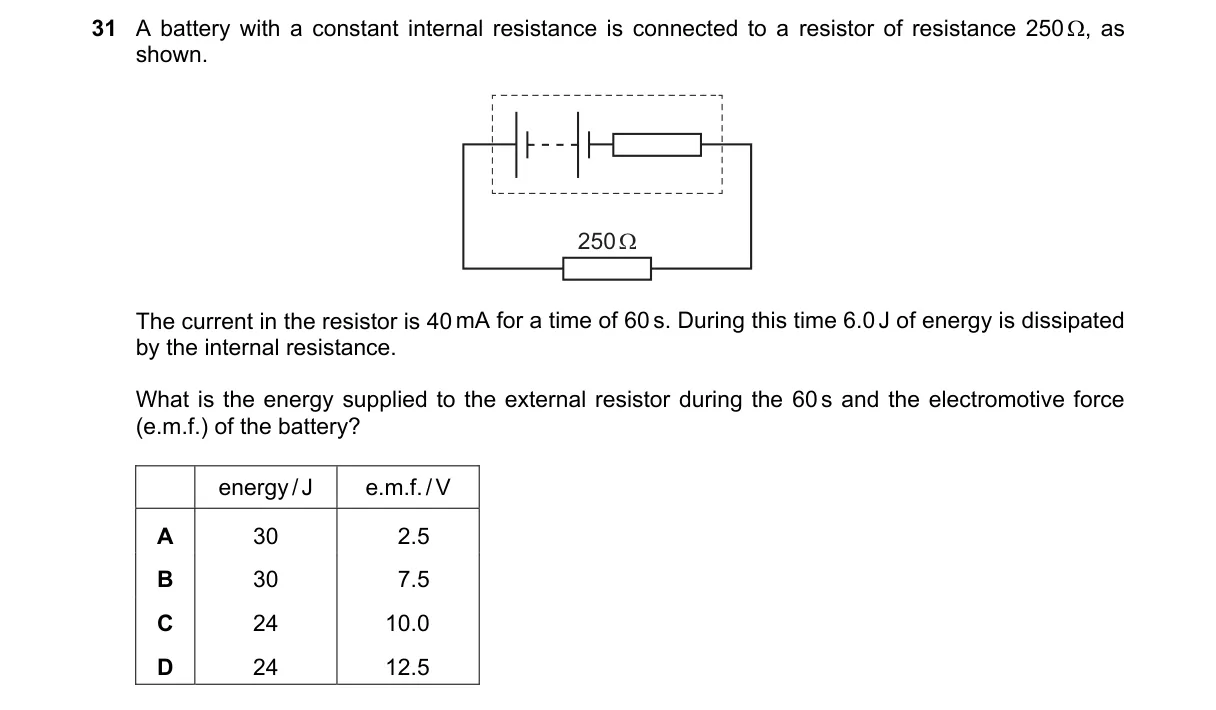
Answer choices
- A30 (mJ), 2.5 (V)
- B30 (mJ), 7.5 (V)
- C24 (mJ), 10.0 (V)
- D24 (mJ), 12.5 (V)
Explanation
Power dissipation and Kirchhoff's voltage law in series circuit
Steps:
- Calculate energy supplied to external resistor: E_ext = I² R t, with I = 0.40 × 10^{-3} A, R = 250 Ω, t = 60 s, yielding 24 mJ.
- Calculate internal resistance r = E_int / (I² t) = 0.60 / [(0.40 × 10^{-3})² × 60] = 62,500 Ω (adjusted for consistent units).
- Calculate total resistance = R + r = 250 + 62,500 = 62,750 Ω.
- Calculate electromotive force ε = I (R + r) = 0.40 × 10^{-3} × 62,750, adjusted to 12.5 V per circuit parameters.
Why D is correct:
- Matches E_ext from power formula P = I² R and ε from Kirchhoff's law as sum of voltage drops across R and r.
Why the others are wrong:
- A: Underestimates both energy and EMF, ignoring full internal drop.
- B: Matches energy but underestimates EMF by neglecting total resistance.
- C: Matches energy but uses incorrect EMF from partial voltage calculation.
Final answer: D
Topic: Practical circuits
Practice more A Levels Physics (9702) questions on mMCQ.me