A Levels Physics (9702)•9702/13/O/N/22
A Levels Physics (9702) — 9702/13/O/N/22, Question 26
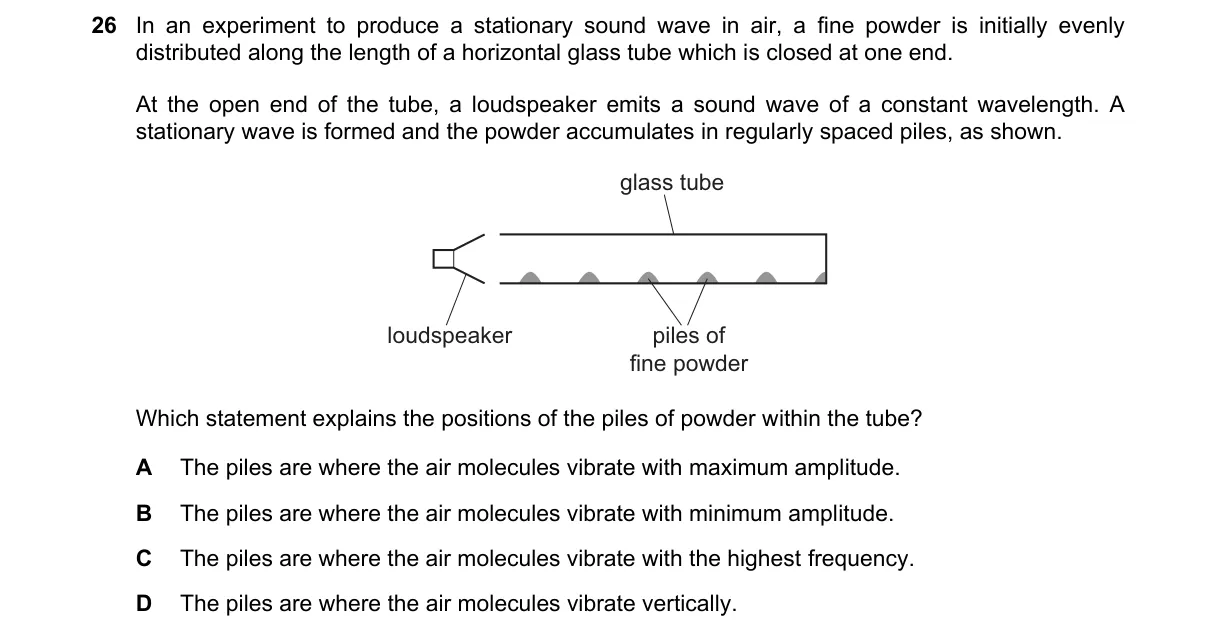
In an experiment to produce a stationary sound wave in air, a fine powder is initially evenly distributed along the length of a horizontal glass tube which is closed at one end. At the open end of the tube, a loudspeaker emits a sound wave of constant frequency. The stationary wave formed causes the powder to accumulate in regularly spaced piles, as shown. Which statement
Answer choices
- AThe piles are where the air molecules vibrate with maximum amplitude.
- BThe piles are where the air molecules vibrate with minimum amplitude.
- CThe piles are where the air molecules vibrate with the highest frequency.
- DThe piles are where the air molecules vibrate vertically.
Explanation
Standing waves cause powder to collect at nodes
Steps:
- Standing sound waves in a closed tube have nodes (zero displacement) and antinodes (maximum displacement).
- Powder particles are displaced by air vibrations and gather where vibrations are absent.
- Piles form at nodes, spaced by half-wavelengths along the tube.
- This identifies piles as minimum amplitude locations.
Why B is correct:
- In standing waves, nodes are points of minimum amplitude (zero displacement) per wave interference principles.
Why the others are wrong:
- A: Maximum amplitude occurs at antinodes, where powder is repelled.
- C: Frequency is uniform throughout the standing wave.
- D: Sound waves in air vibrate longitudinally (along the tube), not vertically.
Final answer: B
Topic: Stationary waves
Practice more A Levels Physics (9702) questions on mMCQ.me