A Levels Physics (9702)•9702/13/O/N/22
A Levels Physics (9702) — 9702/13/O/N/22, Question 22
The period of an electromagnetic wave in a vacuum is 1.0 ns. What are the frequency and wavelength of the wave?
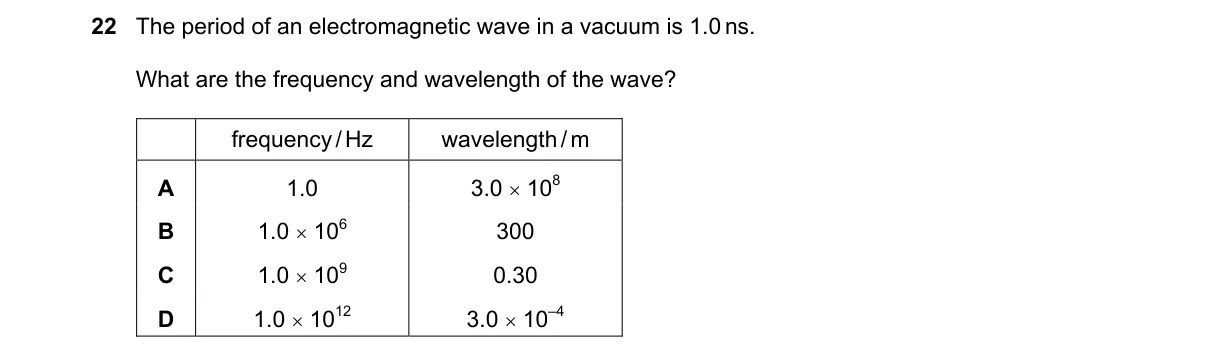
Answer choices
- A1.0 × 10^9 Hz, 3.0 × 10^8 m
- B1.0 × 10^9 Hz, 3.0 × 10^{-1} m
- C1.0 × 10^{10} Hz, 3.0 × 10^{-2} m
- D1.0 × 10^8 Hz, 3.0 × 10^0 m
Explanation
Relate period to frequency and wavelength via wave equations
Steps:
- Convert period: T = 1.0 ns = 1.0 × 10^{-9} s.
- Compute frequency: f = 1/T = 1.0 × 10^9 Hz.
- Use speed of light: c = 3.0 × 10^8 m/s.
- Calculate wavelength: λ = c/f = 3.0 × 10^8 / 1.0 × 10^9 = 3.0 × 10^{-1} m.
Why B is correct:
- Values match f = 1/T and λ = c/f, the definitions for periodic waves in vacuum.
Why the others are wrong:
- A: Wavelength incorrect; λ = c/f = 0.3 m, not 300 m.
- C: Frequency too high; 10^{10} Hz corresponds to T = 0.1 ns, not 1.0 ns.
- D: Frequency too low; 10^8 Hz corresponds to T = 10 ns, not 1.0 ns.
Final answer: B
Topic: Progressive waves
Practice more A Levels Physics (9702) questions on mMCQ.me