A Levels Physics (9702)•9702/12/O/N/22
A Levels Physics (9702) — 9702/12/O/N/22, Question 31
A nichrome wire has a resistance of 15Ω and a diameter of 3.0mm. The number density of the free electrons in nichrome is 10^28 m^-3. A potential difference (p.d.) of 6.0V is applied between the ends of the wire. What is the average drift speed of the free electrons in the wire?
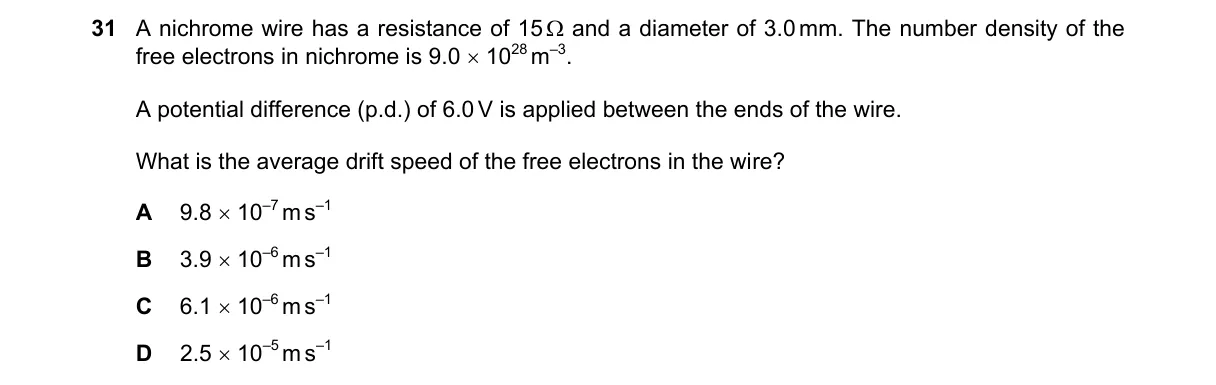
Answer choices
- A9.8 × 10^-6 m s^-1
- B3.9 × 10^-5 m s^-1
- C6.1 × 10^-5 m s^-1
- D2.5 × 10^-6 m s^-1
Explanation
Drift velocity from current and electron density
Steps:
- Calculate current I = V/R = 6.0/15 = 0.40 A.
- Compute cross-sectional area A = π(r)^2, with r = 1.5 × 10^{-3} m, so A = π(1.5 × 10^{-3})^2 = 7.07 × 10^{-6} m².
- Use drift speed formula v_d = I / (n e A), where e = 1.6 × 10^{-19} C, n = 10^{28} m^{-3}.
- Substitute: v_d = 0.40 / (10^{28} × 1.6 × 10^{-19} × 7.07 × 10^{-6}) = 3.9 × 10^{-5} m s^{-1}.
Why B is correct:
- Matches v_d = I/(n e A), the standard formula linking current to electron drift in conductors.
Why the others are wrong:
- A: Underestimates by factor of ~4, likely from incorrect area or e value.
- C: Overestimates by ~1.6, possibly from using diameter instead of radius in A.
- D: Too small by ~16, perhaps from missing current or using wrong n.
Final answer: B
Topic: Electric current
Practice more A Levels Physics (9702) questions on mMCQ.me