A Levels Physics (9702)•9702/12/O/N/22
A Levels Physics (9702) — 9702/12/O/N/22, Question 30
Red light of a single wavelength passes through a diffraction grating. Bright dots are formed on a screen, as shown. The red light is replaced with white light. Which diagram, drawn to the same scale, shows a possible pattern of bright light on the screen?
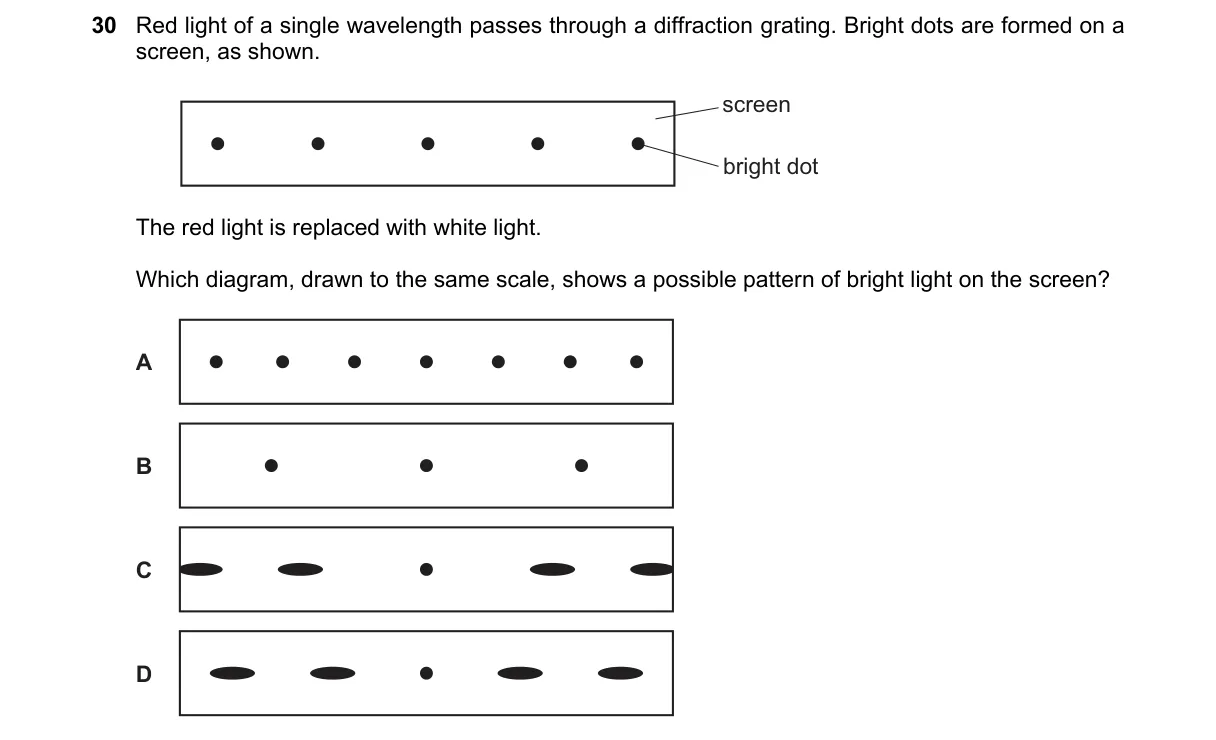
Answer choices
- AOption A
- BOption B
- COption C
- DOption D
Explanation
White light diffraction grating produces dispersed color spectra
Steps:
- Diffraction grating separates light wavelengths using d sinθ = mλ, where longer wavelengths (red) diffract more than shorter ones (violet).
- Red light forms symmetric bright spots at specific angles for each order m.
- White light contains all visible wavelengths, so each order spreads into a continuous spectrum from red to violet.
- Central maximum (m=0) remains white, while side orders show rainbow patterns without discrete dots.
Why D is correct:
- Shows central white spot with colored spectra spreading outward in each order, matching wavelength dispersion in the grating equation.
Why the others are wrong:
- A: Lacks color separation, showing only white spots like monochromatic light.
- B: Displays discrete colored dots instead of continuous spectra.
- C: Has asymmetric or incomplete dispersion, ignoring symmetric grating orders.
Final answer: D
Topic: The diffraction grating
Practice more A Levels Physics (9702) questions on mMCQ.me