A Levels Physics (9702)•9702/12/O/N/22
A Levels Physics (9702) — 9702/12/O/N/22, Question 29
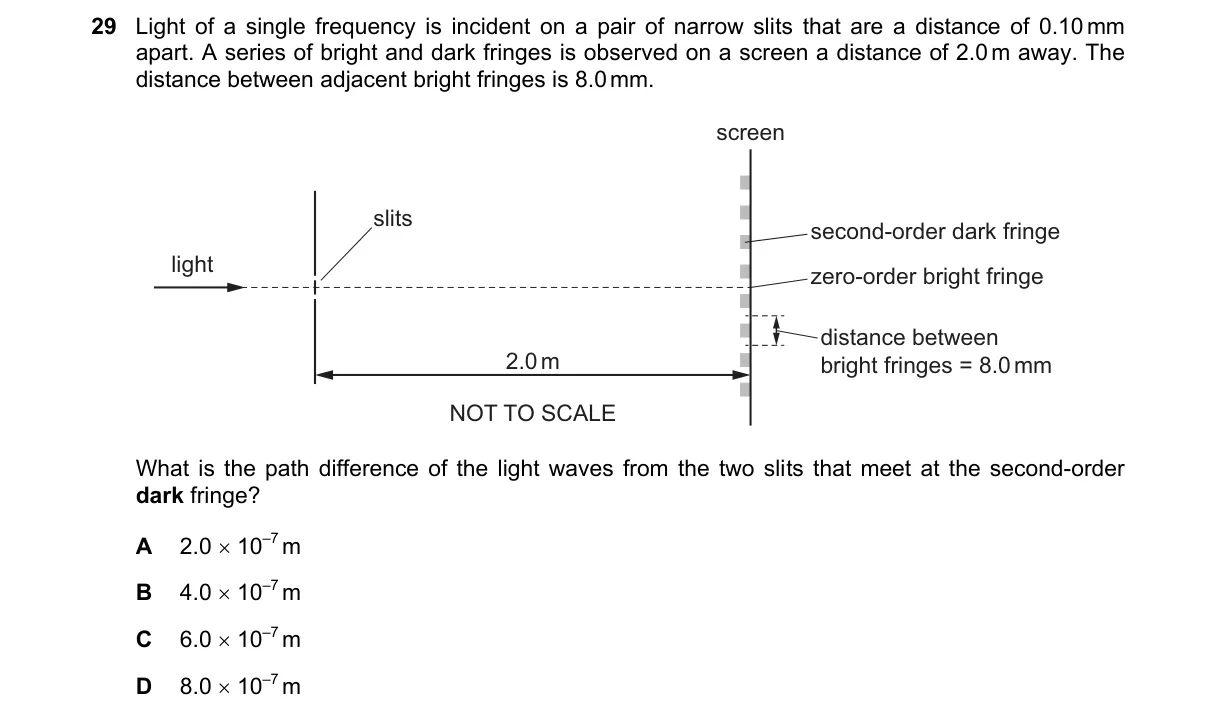
Light of a single frequency is incident on a pair of narrow slits that are a distance of 0.10 mm apart. A series of bright and dark fringes is observed on a screen a distance of 2.0 m away. The distance between adjacent bright fringes is 8.0 mm. What is the path difference of the light waves from the two slits that meet at the second-order dark fringe?
Answer choices
- A2.0 × 10^{-7} m
- B4.0 × 10^{-7} m
- C6.0 × 10^{-7} m
- D8.0 × 10^{-7} m
Explanation
Path difference for dark fringes in double-slit interference
Steps:
- Calculate wavelength λ using fringe spacing β = λL/d: λ = βd/L = (8.0×10^{-3} m)(0.10×10^{-3} m)/(2.0 m) = 4.0×10^{-7} m.
- For dark fringes, path difference δ = (m + 1/2)λ, where m = 0,1,2,... for successive orders.
- Second-order dark fringe corresponds to m=1, so δ = (1 + 1/2)λ = (3/2)λ.
- Substitute λ: δ = (3/2)(4.0×10^{-7} m) = 6.0×10^{-7} m.
Why C is correct:
- Matches δ = (3/2)λ for the second dark fringe, per destructive interference condition.
Why the others are wrong:
- A: Equals λ/2, path difference for first-order dark fringe.
- B: Equals λ, path difference for first-order bright fringe.
- D: Equals 2λ, path difference for second-order bright fringe.
Final answer: C
Topic: Interference
Practice more A Levels Physics (9702) questions on mMCQ.me