A Levels Physics (9702)•9702/12/O/N/22
A Levels Physics (9702) — 9702/12/O/N/22, Question 26
In one experiment a loudspeaker produces a sound wave of constant frequency which is microphoned directly back along its original path by a CRO plate approximately 1m away. The wavelength of the sound may be determined using stationary waves. The intensity of regions of high intensity (loud spots) and low intensity (quiet spots). Which row shows the quantities that are needed? the least possible number measured
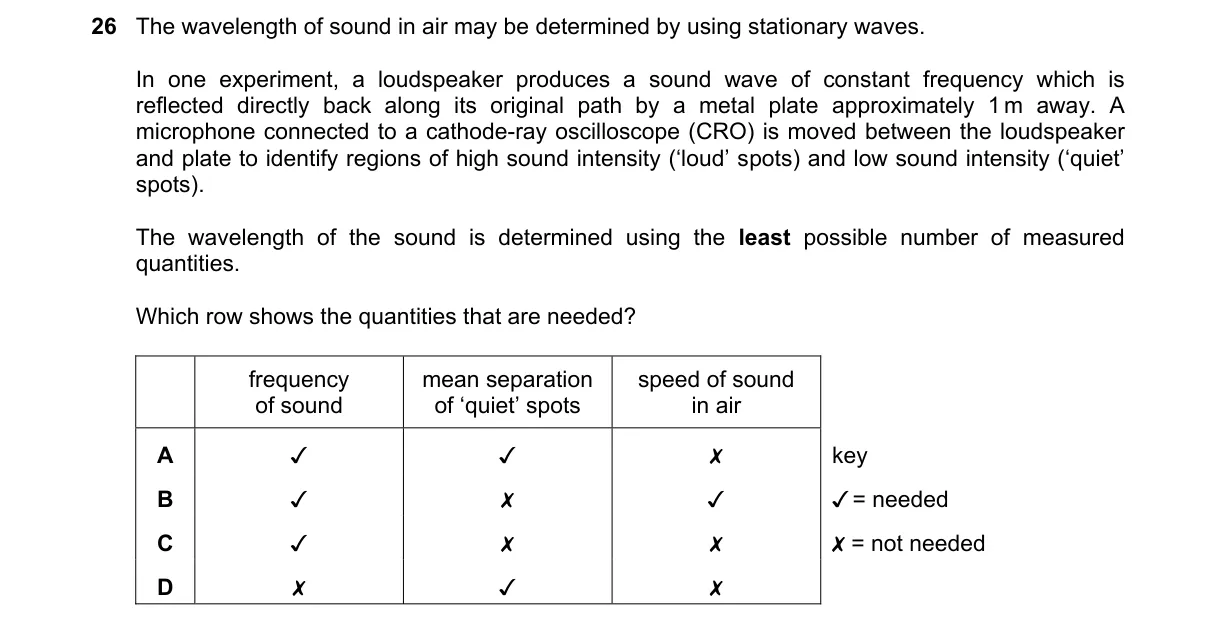
Answer choices
- Afrequency, mean separation of quiet spots
- Bfrequency, speed of sound
- Cfrequency, speed of sound
- Dmean separation of quiet spots
Explanation
Standing Waves for Wavelength Measurement
Steps:
- Sound reflects back from CRO plate, creating interference and standing waves along the path.
- Quiet spots are nodes where destructive interference occurs; distance between consecutive nodes is λ/2.
- Measure mean separation d of quiet spots; wavelength λ = 2d.
- No other measurements required for λ using this method.
Why D is correct:
- In standing sound waves, node separation equals λ/2, so λ = 2 × mean separation of quiet spots (standing wave node definition).
Why the others are wrong:
- A: Frequency is unnecessary; separation alone gives λ via standing wave relation.
- B: Speed and frequency allow λ = v/f, but ignores stationary wave method.
- C: Identical to B; uses wave speed formula, not node measurements.
Final answer: D
Topic: Stationary waves
Practice more A Levels Physics (9702) questions on mMCQ.me