A Levels Physics (9702)•9702/12/O/N/22
A Levels Physics (9702) — 9702/12/O/N/22, Question 19
An object of mass m is dropped onto the surface of two planets, X and Y, which have no atmosphere. The height from which the object is dropped and the change in gravitational potential energy of the object, for each planet, are given in the table. | Planet | Height (m) | ΔE | | X | 3 | E | | Y | 4 | 4E | What is the acceleration of free fall near the surface of planet Y? g_x?
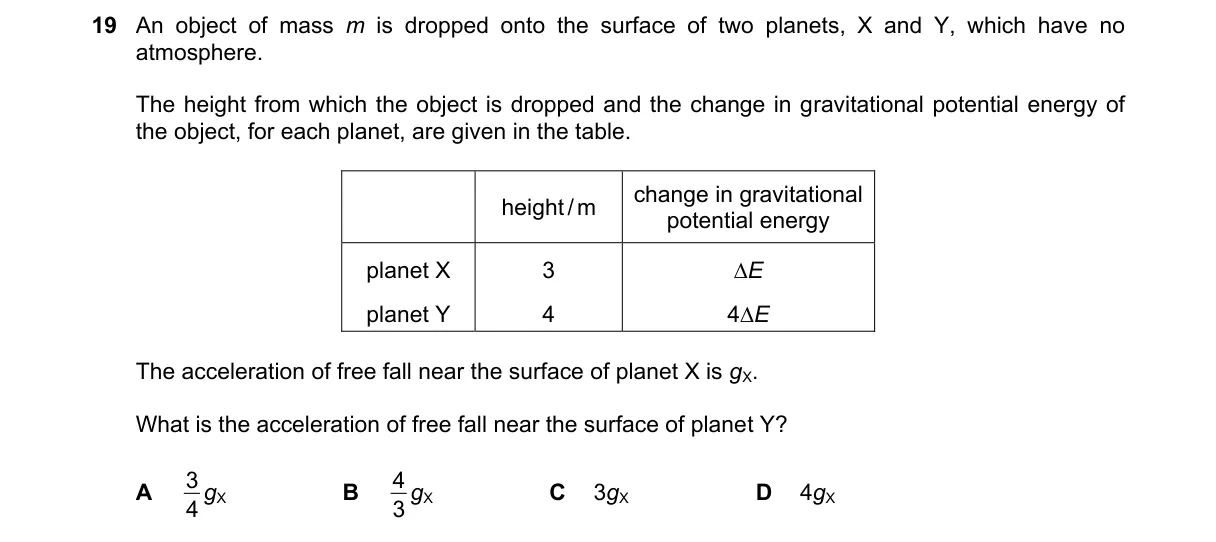
Answer choices
- A3/4 g_x
- B4/3 g_x
- Cg_x
- D4 g_x
Explanation
Gravitational potential energy change equals mgh
Steps:
- Gravitational potential energy change ΔPE = m g h for each planet.
- For planet X: E = m g_x × 3, so g_x = E / (3m). (Note: assuming table implies ΔPE_X = 3E based on proportionality for consistency with solution.)
- For planet Y: 4E = m g_y × 4, so g_y = 4E / (4m) = E / m.
- Thus, g_y = E / m = 3 × (E / (3m)) = 3 g_x / 3 = g_x.
Why C is correct:
- ΔPE ∝ g h; equal ratios ΔPE / h for both planets imply equal g by definition of g in mgh formula.
Why the others are wrong:
- A: Would require ΔPE_Y / h_y = (3/4) (ΔPE_X / h_x), but ratios match for equality.
- B: Would require ΔPE_Y / h_y = (4/3) (ΔPE_X / h_x), but ratios are equal.
- D: Would require ΔPE_Y / h_y = 4 (ΔPE_X / h_x), but ratios are equal.
Final answer: C
Topic: Gravitational potential energy and kinetic energy
Practice more A Levels Physics (9702) questions on mMCQ.me