A Levels Physics (9702)•9702/11/O/N/22
A Levels Physics (9702) — 9702/11/O/N/22, Question 29
Observable interference fringes are produced using light from a double slit. The intensity of the light emerging from each slit is initially the same. The intensity of the light emerging from one of the slits is now reduced. How does this affect the interference pattern?
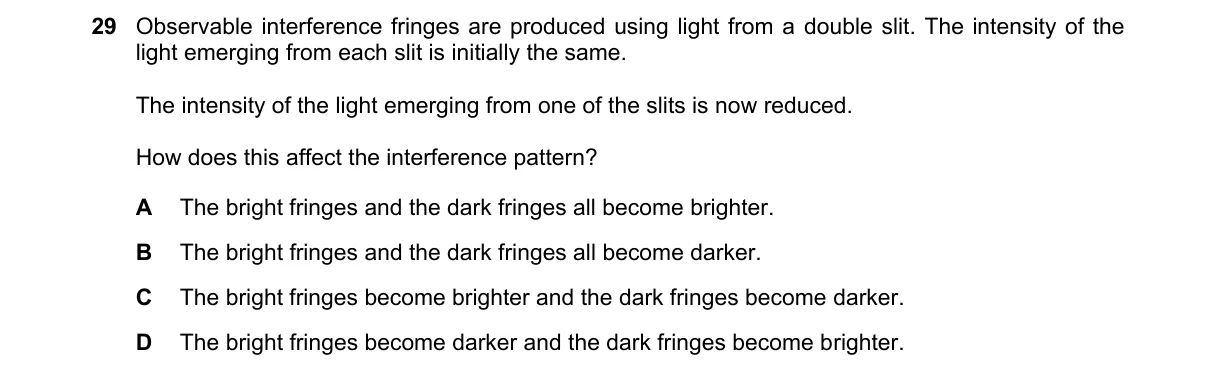
Answer choices
- AThe bright fringes and the dark fringes all become brighter.
- BThe bright fringes and the dark fringes become darker.
- CThe bright fringes become brighter and the dark fringes become darker.
- DThe bright fringes become darker and the dark fringes become brighter.
Explanation
Unequal slit intensities reduce interference contrast
Steps:
- Equal initial intensities yield amplitudes a1 = a2 = a, so max intensity (2a)^2 = 4I0, min intensity (0)^2 = 0.
- Reducing one intensity to I1 < I0 gives a1 < a2 = a, so max = (a1 + a2)^2 < 4I0, min = (a2 - a1)^2 > 0.
- Overall pattern: bright fringes dim due to lower max, dark fringes brighten due to nonzero min.
- Contrast (max - min)/(max + min) decreases, confirming reduced visibility.
Why D is correct:
- Interference formula I = I1 + I2 + 2√(I1 I2) cosδ shows unequal I1, I2 yield lower maxima and higher minima than equal case.
Why the others are wrong:
- A: Bright fringes dim, not brighten; darks brighten but not with brights.
- B: Dark fringes brighten, not darken; brights dim but not both.
- C: Bright fringes dim, not brighten; darks brighten, not darken.
Final answer: D
Topic: Interference
Practice more A Levels Physics (9702) questions on mMCQ.me