A Levels Physics (9702)•9702/11/O/N/22
A Levels Physics (9702) — 9702/11/O/N/22, Question 28
A wave on the surface of water passes through a gap between two barriers and is diffracted, as shown. What happens when the frequency of the wave is halved?
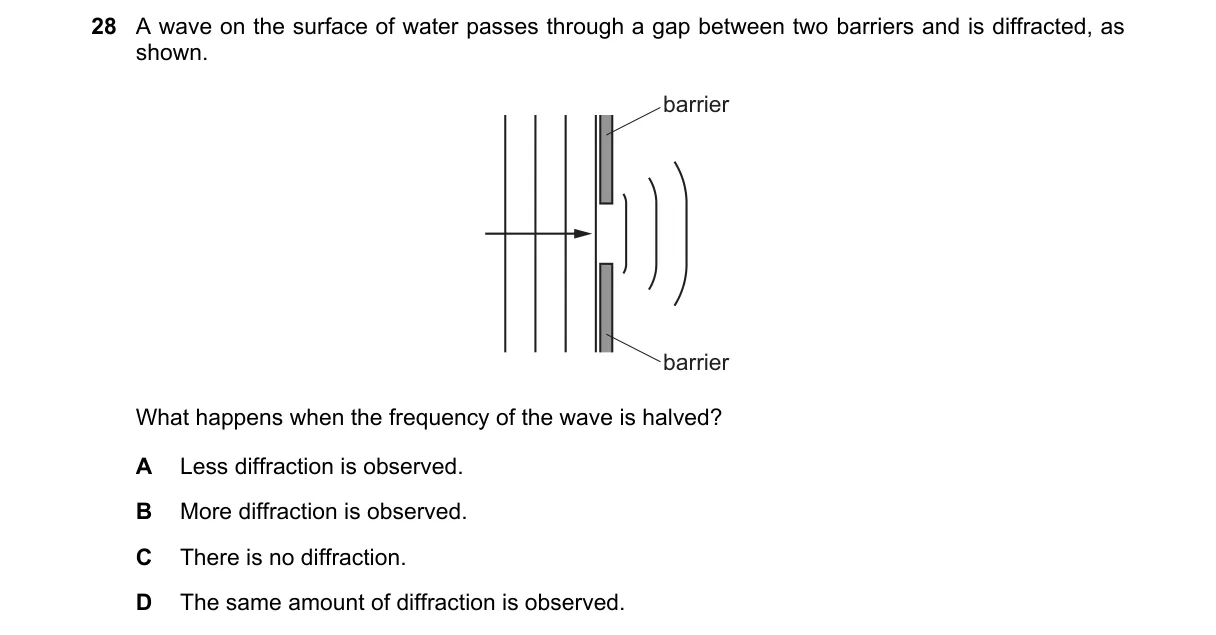
Answer choices
- ALess diffraction is observed.
- BMore diffraction is observed.
- CThere is no diffraction observed.
- DThe same amount of diffraction observed.
Explanation
Diffraction depends on wavelength relative to gap size
Steps:
- Diffraction is most noticeable when wavelength is comparable to or larger than the gap width.
- Wave speed in water remains constant when frequency changes.
- Halving frequency doubles wavelength, since λ = v/f.
- Larger wavelength relative to gap increases diffraction angle and spread.
Why B is correct:
- Doubling wavelength makes waves bend more around barriers, per Huygens' principle, enhancing diffraction.
Why the others are wrong:
- A: Shorter wavelength (higher frequency) reduces diffraction.
- C: Diffraction persists but intensifies with longer wavelength.
- D: Wavelength change alters diffraction extent.
Final answer: B
Topic: Diffraction
Practice more A Levels Physics (9702) questions on mMCQ.me