A Levels Physics (9702)•9702/11/O/N/22
A Levels Physics (9702) — 9702/11/O/N/22, Question 26
When does the principle of superposition apply?
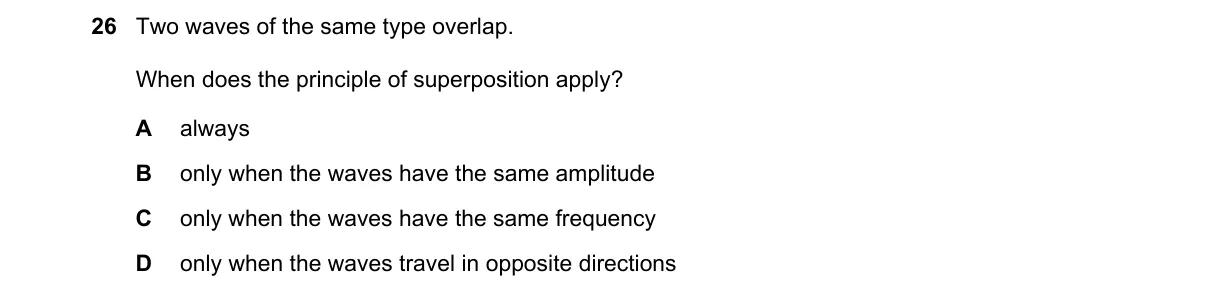
Answer choices
- Aalways
- Bonly when the waves have the same amplitude
- Conly when the waves have the same frequency
- Donly when the waves travel in opposite directions
Explanation
Principle of Superposition in Wave Interference
Steps:
- Recall that the principle of superposition states the net displacement of a medium is the algebraic sum of individual wave displacements.
- Identify that this applies to linear wave equations, where waves do not interact to change each other's properties.
- Evaluate choices: Superposition requires no nonlinear effects, but no restrictions on amplitude, frequency, or direction.
- Conclude it holds universally for linear waves like sound or light in non-dispersive media.
Why A is correct:
- The principle applies always to linear waves, as per the wave equation solution where total wave function is the sum of individual solutions, without conditions on amplitude, frequency, or direction.
Why the others are wrong:
- B: Amplitude differences do not affect superposition; waves add regardless of size.
- C: Different frequencies still superpose; beats occur from this addition.
- D: Opposite directions are not required; waves in same or varying directions superpose equally.
Final answer: A
Topic: Interference
Practice more A Levels Physics (9702) questions on mMCQ.me