A Levels Physics (9702)•9702/11/O/N/22
A Levels Physics (9702) — 9702/11/O/N/22, Question 14
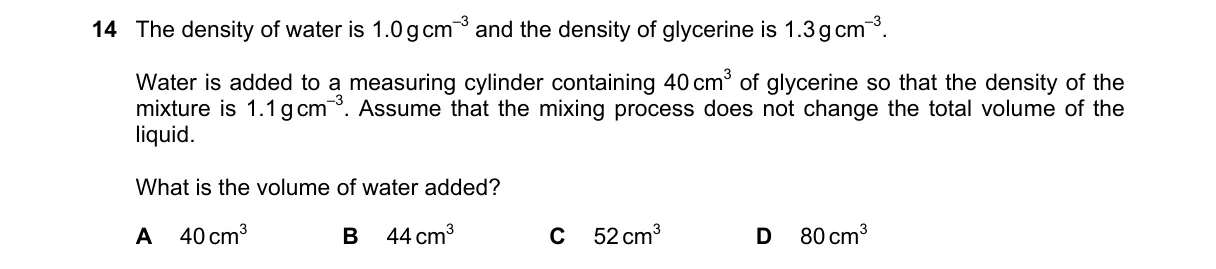
The density of water is 1 g/cm³ and the density of glycerine is 1.3 g/cm³. Water is added to a measuring cylinder containing 40 cm³ glycerine so that the mixture is 1.1 g/cm³. Assume that the mixing process does not change the total volume of the liquid. What is the volume of water added?
Answer choices
- A40 cm³
- B44 cm³
- C52 cm³
- D80 cm³
Explanation
Mixture density from mass conservation
Steps:
- Calculate mass of glycerine: 1.3 g/cm³ × 40 cm³ = 52 g.
- Let volume of water added be V cm³; its mass is 1 g/cm³ × V = V g.
- Total mass = 52 g + V g; total volume = 40 cm³ + V cm³.
- Set mixture density: (52 + V) / (40 + V) = 1.1; solve to get V = 80 cm³.
Why D is correct:
- 80 cm³ yields total mass 132 g and volume 120 cm³, so density = 132/120 = 1.1 g/cm³ exactly, per the conservation of mass formula.
Why the others are wrong:
- A: 40 cm³ gives density 92/80 = 1.15 g/cm³, too high.
- B: 44 cm³ gives density 96/84 ≈ 1.14 g/cm³, too high.
- C: 52 cm³ gives density 104/92 ≈ 1.13 g/cm³, too high.
Final answer: D
Topic: Density and pressure
Practice more A Levels Physics (9702) questions on mMCQ.me