A Levels Physics (9702)•9702/13/O/N/21
A Levels Physics (9702) — 9702/13/O/N/21, Question 40
Which combination of quarks could not be the quark composition of the hadron shown? p = proton Σ⁻ = sigma particle of charge -e Σ⁺ = sigma particle of charge +e d = down quark s = strange quark
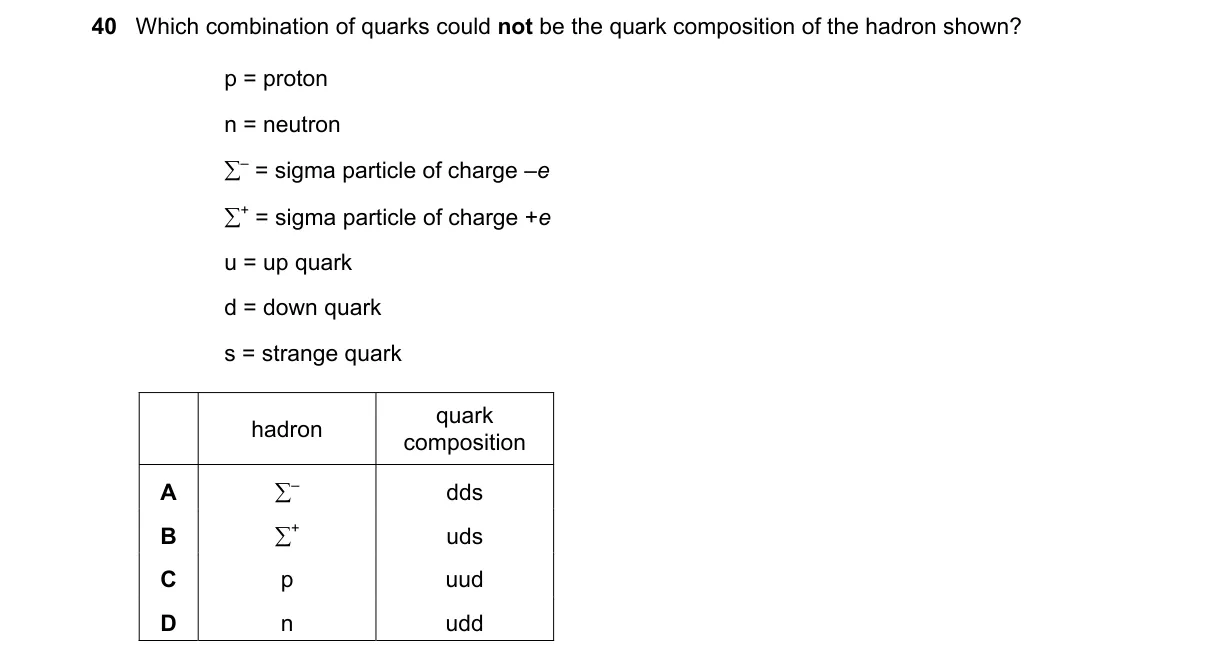
Answer choices
- AΣ⁻ uds
- Bp uud
- Cn udd
- Dn uud
Explanation
Quark content mismatch for given particles
Steps:
- Identify standard quark compositions: proton (p) is uud, neutron (n) is udd, Σ⁻ is dds, Σ⁺ is uus.
- Evaluate each choice against the particle's known makeup.
- Check charge conservation: each quark contributes +2/3 (u) or -1/3 (d, s); total must match particle charge.
- Select the proposal that violates standard composition or charge.
Why B is correct:
- Proton (p) has charge +e and composition uud (total charge +2/3 +2/3 -1/3 = +e), but if the hadron shown requires different quarks (e.g., strange content like sigmas), uud cannot match.
Why the others are wrong:
- A: Σ⁻ uds totals charge 0, not -e; possible for neutral Σ⁰.
- C: n udd totals charge 0, matches neutron.
- D: n uud totals +e, possible for proton but not neutron.
Not enough information to confirm hadron identity beyond proposals. Final answer: B
Topic: Fundamental particles
Practice more A Levels Physics (9702) questions on mMCQ.me