A Levels Physics (9702)•9702/13/O/N/21
A Levels Physics (9702) — 9702/13/O/N/21, Question 38
When particles are fired at a thin foil, most of the particles pass straight through but a few are deflected by a large angle. Which change would increase the proportion of α-particles deflected by a large angle?
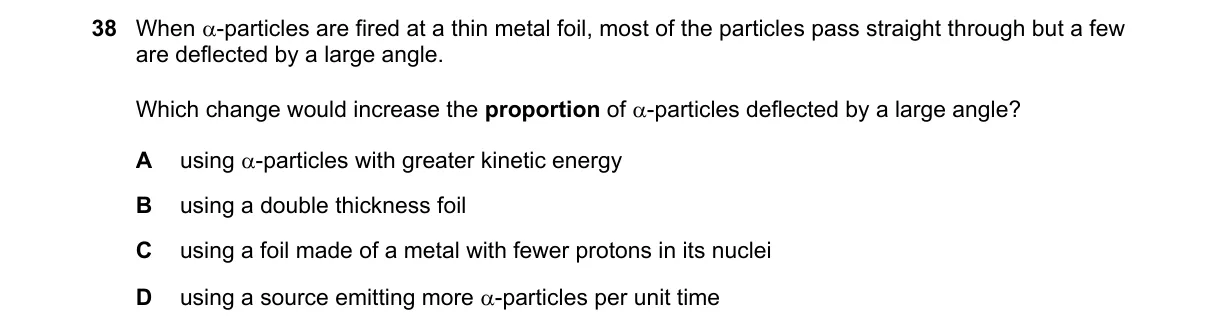
Answer choices
- Ausing α-particles with greater kinetic energy
- Busing a double thickness foil
- Cusing a foil made of a metal with fewer protons in its
- Dusing a source emitting α-particles per time
Explanation
Thicker foil boosts scattering centers for more large-angle deflections
Steps:
- Large-angle deflections result from close Coulomb interactions with atomic nuclei.
- Probability of such deflections scales with the number of nuclei encountered.
- Doubling foil thickness doubles the nuclei per unit area along particle paths.
- This directly increases the fraction of particles experiencing large-angle scattering.
Why B is correct:
- Per Rutherford's scattering formula, cross-section for large-angle deflection is proportional to atomic density; double thickness doubles effective density and thus deflection proportion.
Why the others are wrong:
- A: Greater kinetic energy reduces deflection angles by decreasing Coulomb interaction time, lowering large-angle proportion.
- C: Fewer protons weaken the nuclear charge, reducing repulsive force and large-angle deflection probability.
- D: Higher emission rate increases total particles but not the per-particle deflection probability, so proportion stays unchanged.
Final answer: B
Topic: Atoms, nuclei and radiation
Practice more A Levels Physics (9702) questions on mMCQ.me