A Levels Physics (9702)•9702/13/O/N/21
A Levels Physics (9702) — 9702/13/O/N/21, Question 35
A wire of uniform cross-section has resistance R. A second wire is made of the same material but twice as long and has twice the diameter of the first wire. What is the resistance of the second wire?
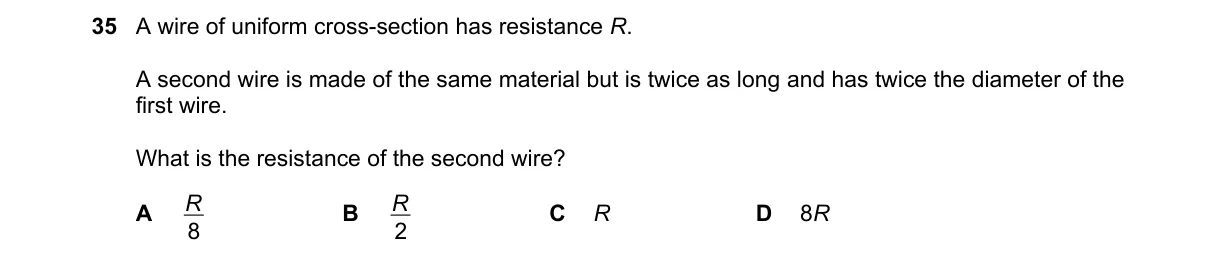
Answer choices
- AR/8
- BR/2
- CR
- D8R
Explanation
Resistance depends on length and cross-sectional area
Steps:
- Resistance R = ρL/A, where ρ is resistivity, L is length, A is cross-sectional area.
- For the second wire, length L₂ = 2L₁, so resistance factor from length is ×2.
- Diameter d₂ = 2d₁, so radius r₂ = 2r₁; area A = πr², thus A₂ = π(2r₁)² = 4πr₁² = 4A₁, resistance factor from area is ÷4.
- Total resistance R₂ = R₁ × (L₂/L₁) × (A₁/A₂) = R × 2 × (1/4) = R/2.
Why B is correct:
- Formula R = ρL/A shows resistance doubles with length but quarters with quadrupled area (from doubled diameter), yielding R/2.
Why the others are wrong:
- A ignores area increase, underestimating by factor of 8.
- C assumes equal resistance, neglecting length and area changes.
- D overestimates by only considering length doubling without area effect.
Final answer: B
Topic: Resistance and resistivity
Practice more A Levels Physics (9702) questions on mMCQ.me