A Levels Physics (9702)•9702/13/O/N/21
A Levels Physics (9702) — 9702/13/O/N/21, Question 23
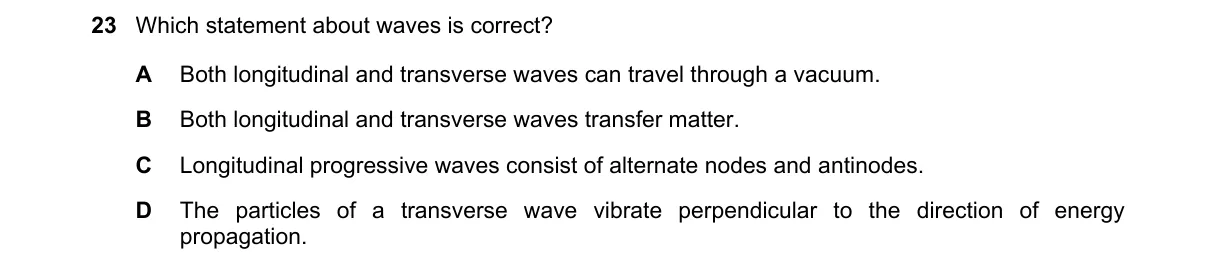
Which statement about waves is correct?
Answer choices
- ABoth longitudinal and transverse waves can travel through a vacuum.
- BBoth longitudinal and transverse waves transfer matter.
- CLongitudinal progressive waves consist of alternate nodes and antinodes.
- DIn a transverse wave vibrations are perpendicular to the direction of energy propagation.
Explanation
Wave Properties and Types
Steps:
- Define transverse waves: vibrations perpendicular to propagation direction.
- Define longitudinal waves: vibrations parallel to propagation direction.
- Evaluate options against these definitions and known wave behaviors.
- Identify the option that accurately describes transverse wave motion.
Why D is correct:
- By definition, transverse waves have particle vibrations perpendicular to the wave's energy propagation direction, as seen in light or water waves.
Why the others are wrong:
- A: Only transverse waves (e.g., electromagnetic) travel through vacuum; longitudinal waves (e.g., sound) require a medium.
- B: Waves transfer energy, not matter; particles oscillate but do not move with the wave.
- C: Nodes and antinodes occur in standing waves, not progressive longitudinal waves, which have compressions and rarefactions.
Final answer: D
Topic: Transverse and longitudinal waves
Practice more A Levels Physics (9702) questions on mMCQ.me