A Levels Physics (9702)•9702/12/O/N/21
A Levels Physics (9702) — 9702/12/O/N/21, Question 36
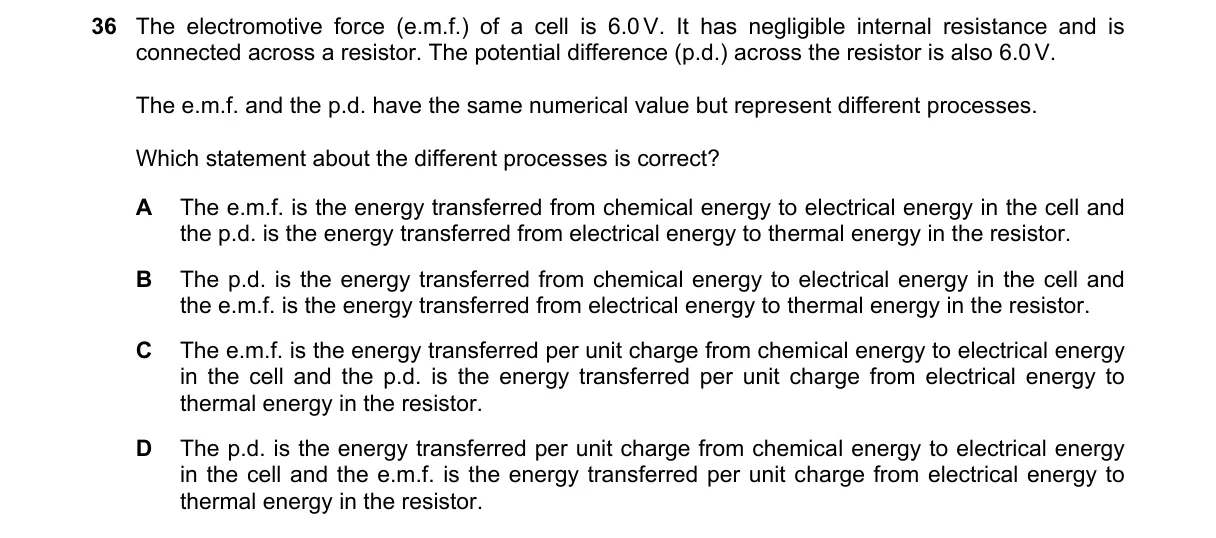
The emf is the energy transferred per unit charge from chemical energy to electrical energy in the cell. The p.d. is the energy transferred per unit charge from electrical energy to thermal energy in the resistor. 36. The electromotive force (emf) of a cell is 6.0 V. It has negligible internal resistance and the emf and p.d. have the same numerical value (p.d. across resistor also 6.0 V). Which statement about the different processes is correct?
Answer choices
- AThe p.d. is the energy transferred from chemical energy to thermal energy in the resistor and
- BThe emf is the energy transferred from chemical energy to thermal energy in the cell and
- Cin the cell and p.d. is the energy per unit charge from electrical energy to thermal energy in the resistor.
- DThe cell and the emf is the energy per unit charge from chemical energy to electrical energy in the cell and the p.d. is the energy transferred per unit charge from electrical energy to thermal energy in the resistor.
Explanation
Distinguishing emf from potential difference (p.d.) in energy transfers
Steps:
- Emf equals work done by cell per unit charge, converting chemical to electrical energy.
- P.d. equals energy dissipated per unit charge across resistor, converting electrical to thermal energy.
- With negligible internal resistance and p.d. = emf = 6.0 V, all electrical energy from cell transfers to thermal in resistor.
- Evaluate options against these definitions to identify the matching statement.
Why C is correct:
- C accurately states emf as energy per unit charge from chemical to electrical in cell, and p.d. from electrical to thermal in resistor, aligning with standard definitions.
Why the others are wrong:
- A incorrectly attributes chemical-to-thermal transfer directly to p.d., bypassing electrical energy.
- B wrongly claims emf involves thermal energy in cell, not electrical.
- D is grammatically incomplete and redundantly mentions "the cell" without clear energy pathway distinction.
Final answer: C
Topic: Potential difference and power
Practice more A Levels Physics (9702) questions on mMCQ.me