A Levels Physics (9702)•9702/12/O/N/21
A Levels Physics (9702) — 9702/12/O/N/21, Question 35
The graphs show the variation with potential difference V of the current I for three circuit components. Graph X, Graph Y, Graph Z. The components are a metal wire at constant temperature, a semiconductor diode and a filament lamp. Which row correctly identifies
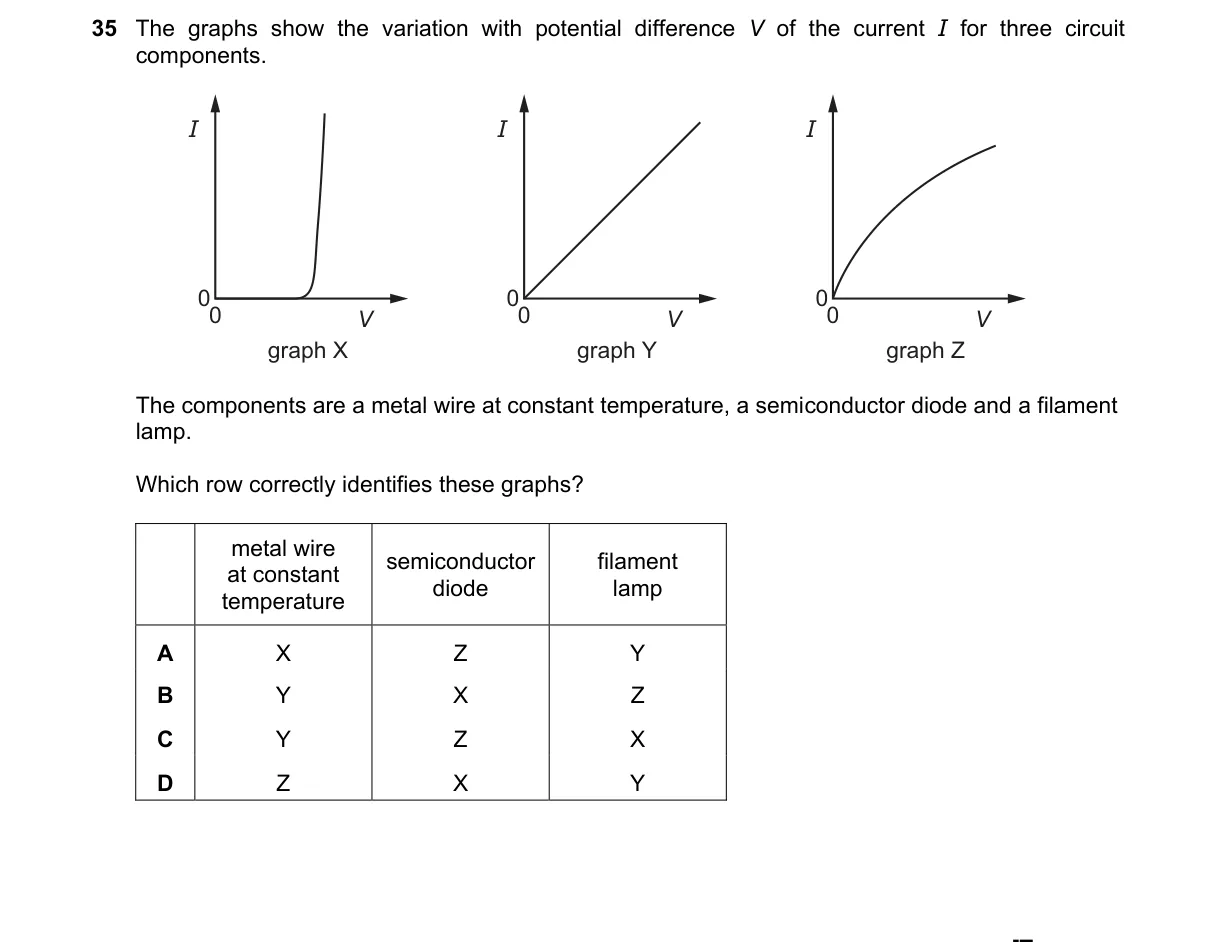
Answer choices
- Ametal wire at constant temperature: X, semiconductor diode: Z, filament lamp: Y
- Bmetal wire at constant temperature: Y, semiconductor diode: X, filament lamp: Z
- Cmetal wire at constant temperature: Y, semiconductor diode: Z, filament lamp: X
- Dmetal wire at constant temperature: Z, semiconductor diode: X, filament lamp: Y
Explanation
Identifying I-V characteristics of circuit components
Steps:
- Metal wire at constant temperature shows ohmic behavior: straight line through origin (resistance constant, I ∝ V).
- Semiconductor diode exhibits rectification: low current for reverse bias, exponential increase for forward bias (asymmetric curve).
- Filament lamp has resistance increasing with temperature: initial steep slope flattens as V rises (non-linear upward curve).
- Match graphs: Y (straight line) to wire, X (asymmetric) to diode, Z (flattening curve) to lamp.
Why B is correct:
- Option B assigns Y (ohmic straight line) to wire per Ohm's law (V = IR, constant R), X (rectifying asymmetry) to diode, and Z (temperature-dependent curve) to lamp.
Why the others are wrong:
- A: Swaps diode and lamp; diodes aren't symmetric curves.
- C: Assigns straight line to lamp; lamps aren't ohmic.
- D: Gives straight line to diode; diodes aren't linear.
Final answer: B
Topic: Resistance and resistivity
Practice more A Levels Physics (9702) questions on mMCQ.me