A Levels Physics (9702)•9702/12/O/N/21
A Levels Physics (9702) — 9702/12/O/N/21, Question 23
The table contains descriptions and examples of waves. Which row is correct?
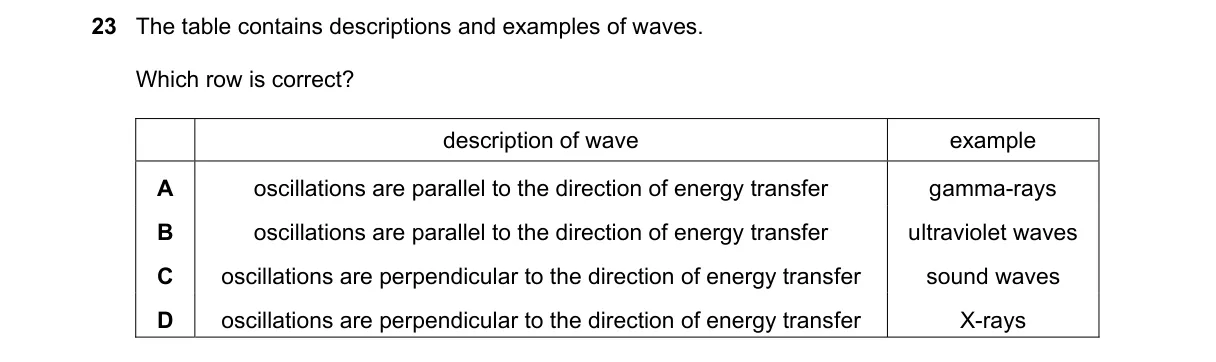
Answer choices
- Aoscillations are parallel to the direction of energy transfer gamma-rays
- Boscillations are parallel to the direction of energy transfer ultraviolet waves
- Coscillations are perpendicular to the direction of energy transfer sound waves
- Doscillations are perpendicular to the direction of energy transfer x-rays
Explanation
Distinguishing transverse and longitudinal waves
Steps:
- Recall that longitudinal waves have oscillations parallel to the direction of energy transfer, like sound waves.
- Recall that transverse waves have oscillations perpendicular to the direction of energy transfer, like electromagnetic waves.
- Identify examples: sound is longitudinal; gamma-rays, ultraviolet, and x-rays are all electromagnetic, so transverse.
- Match options to these definitions to find the correct description.
Why D is correct:
- X-rays are electromagnetic waves, which are transverse by definition, meaning particle oscillations occur perpendicular to the propagation direction.
Why the others are wrong:
- A: Gamma-rays are electromagnetic (transverse), so oscillations are perpendicular, not parallel.
- B: Ultraviolet waves are electromagnetic (transverse), so oscillations are perpendicular, not parallel.
- C: Sound waves are longitudinal, so oscillations are parallel, not perpendicular.
Final answer: D
Topic: Transverse and longitudinal waves
Practice more A Levels Physics (9702) questions on mMCQ.me